
High Risk Customer: Signals, Segments and How to Respond
Blocking every high risk customer is blunt advice. It treats a stolen-card purchase, a confusing subscription renewal and a genuine delivery failure as the same problem, even though each calls for a different response. Automatic refunds can be just as wasteful when a merchant has strong evidence that the customer received and used the purchase.
A better approach is to identify what makes the account risky, what the records prove and which action protects the most value. That means separating abusive behavior from legitimate customers who need a service fix, not assuming that every dispute is fraud.
What Makes a Customer High Risk
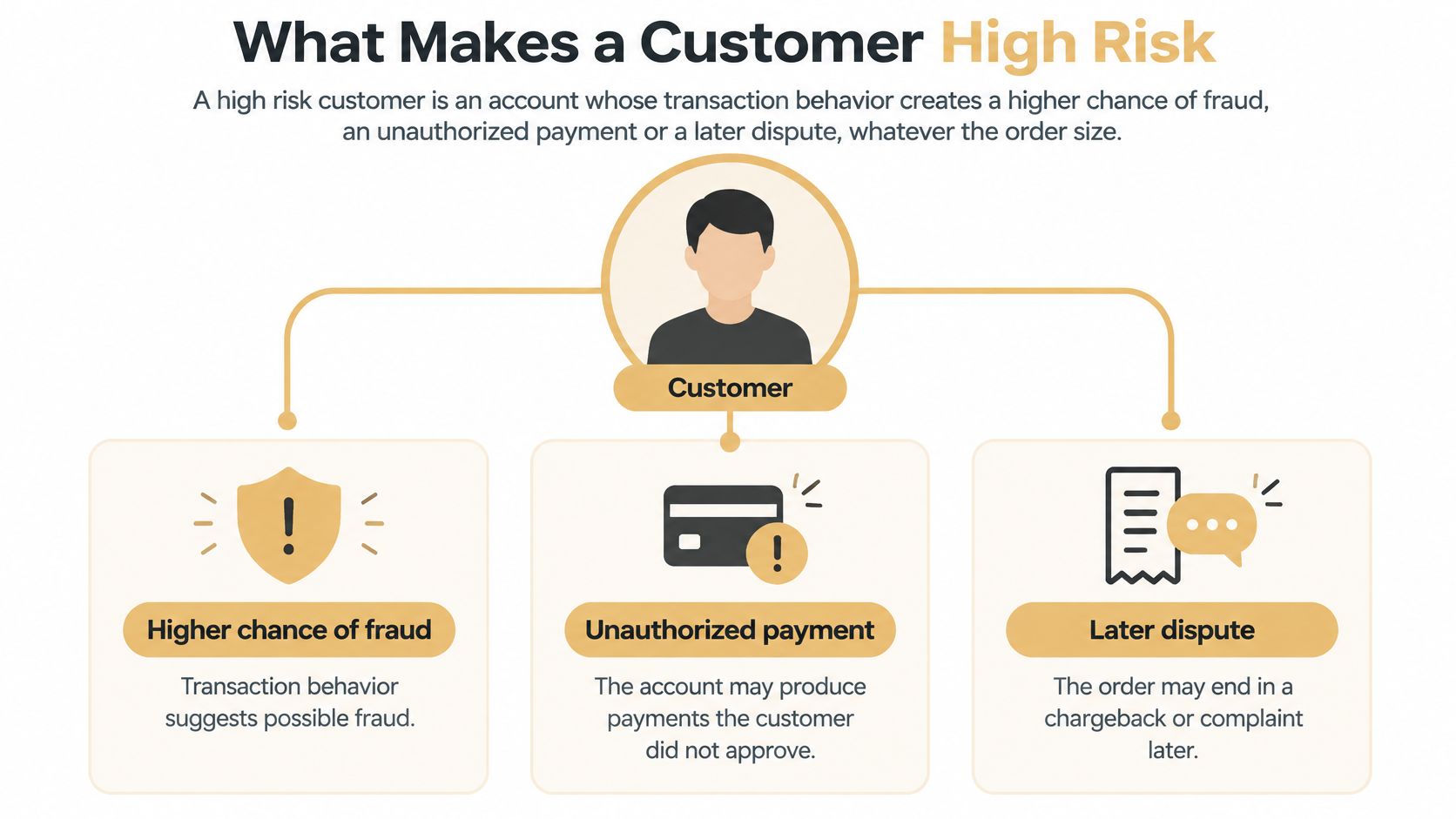
A high risk customer is an account whose transaction behavior creates a higher chance of fraud, an unauthorized payment or a later dispute, whatever the order size. Order value tells you how much revenue is available. It doesn't tell you whether that revenue will stay collected.
Think of a hotel front desk. A guest with a large reservation can still create the most trouble if the card keeps declining, the booking details keep changing and the room is damaged. The desk needs to judge behavior, not just the reservation total.
Online merchants face the same distinction. A repeat buyer who suddenly changes their email, adds an unfamiliar delivery address and tries different cards deserves attention, even if their previous orders were profitable.
Separate payment exposure from customer value
The scale is substantial: the FTC's 2024 Consumer Sentinel Data Book recorded approximately 6.5 million consumer reports, with 38% of fraud reports stating a monetary loss, reported fraud losses exceeding $12 billion and a median reported fraud loss of $497. Those are consumer-report figures, not merchant chargeback rates, but they show why exposure isn't confined to exceptional, high-value incidents.
For a merchant, the underlying problem can take different forms:
- Identity fraud: Someone creates or operates an account using another person's identity.
- Unauthorized payment: A real payment credential is used without the cardholder's approval.
- Post-purchase conflict: A legitimate buyer later challenges delivery, billing, cancellation or the product itself.
Your controls should reflect those differences. Refund history, payment attempts, account changes, shipping anomalies and recurring billing behavior tell you more than an industry label alone.
Practical rule: Keep customer value and payment risk as separate fields. A commercially valuable account can still require tighter payment controls.
Relationship signals also deserve their own interpretation. CleanMyList's guide to assess churn risk with email data offers context for evaluating retention, but disengagement shouldn't be treated as proof of payment fraud.
When investigating a high chargeback rate, examine customer patterns over time rather than labeling everyone associated with a disputed order as abusive. The useful question is what changed and whether your team can explain it.
Warning Signals to Check at Checkout and After
Signals work in combinations. An address mismatch may be a gift purchase. A new device may belong to a customer replacing their phone. As a starting review rule, I would route accounts with multiple independent warning signs to manual review rather than automatically decline them.
Organize checks around the moments when your team can act: identity and device checks before purchase, address and delivery checks during fulfillment, and refund, cancellation and account-change checks afterward.
| Signal | What It May Indicate | First Check |
|---|---|---|
| Billing and shipping address mismatch | Stolen card or proxy buyer | Compare AVS result and past delivery addresses |
| Several cards tried from one device or account | Card testing or account takeover | Count attempts within the last hour |
| Email address created shortly before a large order | Disposable or synthetic identity | Check email age and prior orders |
| Rush shipping to a new destination | Fraud or resale of goods | Confirm the address against earlier orders |
| Repeated refund requests on one account | Refund abuse | Pull refund history and dispute count |
| Subscription cancelled soon after a renewal charge | Renewal confusion or intent to dispute | Check the cancellation log and reminder emails |
| Login or contact details changed before purchase | Account takeover | Review change timestamps and device history |
| Customer claims non-delivery but tracking shows delivery | First-party misuse | Check carrier tracking and delivery confirmation |
Read the signal before choosing the action
For an address mismatch, inspect the address verification service result, or AVS, alongside previous successful deliveries. Check the card verification code result, or CVC, too, but don't mistake either check for proof that the person placing the order owns the card.
With multiple card attempts, inspect the sequence, not just the final approval. Repeated failures followed by a successful payment from the same device deserve a different response from a known customer correcting an expired card.
For a new email address, distinguish the age of the mailbox from the age of its domain. You may not have reliable mailbox-creation data, so use available account history and disposable-domain checks rather than presenting an estimated age as fact.
Rush delivery to an unfamiliar address becomes more concerning when the customer also changes contact details or uses an unfamiliar device. Confirm the destination through an established contact channel before releasing the order.
Use post-purchase records carefully
Repeated refund requests require reasons and outcomes, not just a count. A customer repeatedly receiving damaged goods may reveal a packaging problem rather than abuse.
A cancellation after renewal calls for a timestamp comparison. Check when the customer tried to cancel, what your system recorded and whether reminder messages were sent.
For login or email changes, compare device history and account-recovery events. Also compare billing country with IP country, allowing for travel and privacy tools rather than treating geography alone as a verdict.
A delivered tracking status isn't conclusive proof that the buyer personally received the parcel. Inspect the delivery location, photograph and any carrier investigation before alleging misuse.
Record the signal, the date, the check result and the decision in the order notes. An unexplained risk label won't help the next reviewer.
Keep eligibility controls distinct from fraud scoring. Pink Smoke Shop's explanation of adult-only access to vaping products provides context for age-verification workflows, which answer a different question from whether a payment is authorized.
If you're investigating a Shopify hold, preserve the reasoning behind approvals and declines. An auditable decision trail is more useful than a list of unexplained flags.
Industries Where High Risk Customers Concentrate
| Industry or Model | Main Risk Driver | Typical Dispute Pattern |
|---|---|---|
| Nutraceuticals and supplements | Trial offers and auto-ship renewals | Renewal confusion and unauthorized claims |
| Travel | High-value, date-sensitive bookings | Cancellation and no-show disputes |
| Subscription and SaaS | Recurring billing | Forgotten renewals and cancellation disputes |
| Digital goods | Instant delivery with no physical proof | Item not received despite download |
| Gambling, gaming and crypto exchanges | High-value transfers and fast cash-out | Unauthorized payments |
Industry is a starting filter, not a customer verdict. These business models create different opportunities for confusion, service failure and misuse. Use the table to identify relevant mechanisms, not to assume every customer in a category is dangerous.
Mastercard's analysis of chargeback costs reported that high-risk categories, including gambling, gaming and cryptocurrency exchanges, had an average chargeback amount of US$99 in 2025. That measure describes the chargeback amount, not the merchant's complete cost or the likelihood that a particular customer will dispute.
Match the control to the business model
A supplement trial can become a dispute when it renews at a higher price the buyer didn't expect. Preserve the checkout offer, renewal terms and shipment history so your reviewer can distinguish misleading presentation from a buyer ignoring clear terms.
In travel, the service date matters as much as the purchase date. Say a customer books a flight and requests cancellation close to departure. The review needs the fare conditions, cancellation timing and service status, not just proof that the card was approved.
For subscription and SaaS businesses, forgotten renewals and failed cancellation workflows need different remedies. A software renewal after continued account use isn't the same case as a renewal after an unsuccessful cancellation attempt.
Capture evidence that fits the product
A digital-goods merchant can't rely on a shipping label. If a buyer downloads an ebook and later reports non-receipt, preserve the download event, account access and support correspondence, while checking whether the file was accessible.
For gambling, gaming and crypto exchanges, review funding and withdrawal behavior together. Fast movement of value makes it important to resolve suspicious account changes before allowing further activity, rather than waiting for a payment complaint.
- Recurring billing: Check whether customers understand when and why another charge will occur.
- Delayed delivery: Preserve the promised date and communications about changes.
- Large commitments or fast payouts: Review unresolved identity and payment anomalies before releasing value.
Write down which drivers apply to your own model. A merchant outside these categories may share the same exposure, while a business inside them may have clear terms and well-controlled fulfillment.
Separate Customer Segments and Choose Refund, Contest or Retain
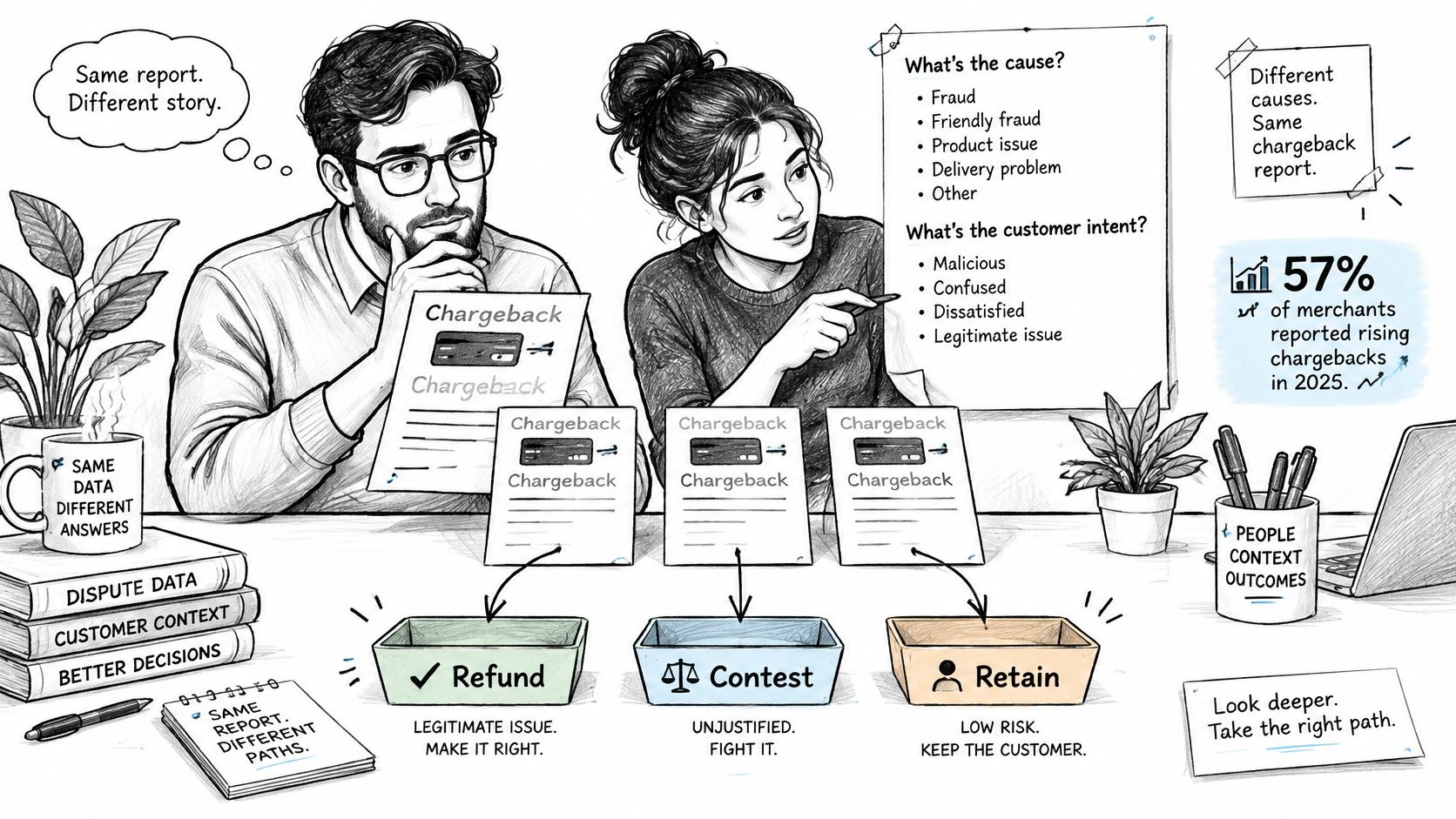
A refund request or chargeback can look identical in a report regardless of its cause. Sort the cause before choosing the remedy. Otherwise, your team may refund abuse while contesting a genuine service failure.
The Paypers' 2025 payment-fraud retrospective reported that 57% of surveyed merchants experienced rising refund or policy abuse, while six in ten reported increasing first-party misuse. That supports examining misuse separately from stolen-card fraud, not assuming that every unhappy buyer is acting fraudulently.
Pull the record that can establish the cause
Unauthorized fraud requires the transaction history and device log. Look for mismatched identity details, an unseen device and account changes that the established customer can't explain. If the account was taken over, securing it and helping the legitimate owner recover access is different from permanently blocking that person.
For friendly fraud, pull fulfillment proof, delivery photographs and usage history. Treat the label as a working classification, not a conclusion: evidence of delivery doesn't establish that a customer intentionally lied.
Subscription-renewal confusion requires cancellation logs, reminder emails and the renewal terms shown at purchase. A support ticket asking to stop billing can matter even if the customer didn't complete your preferred cancellation flow.
For delivery failure, inspect carrier scans and exceptions. A parcel lost by the carrier is a fulfillment problem the merchant needs to resolve, not a reason to add the buyer to an abuse list.
Refund-policy disputes require the checkout record and the policy version the buyer accepted. A policy added later, hidden from view or unrelated to the complaint won't make a persuasive response.
A valuable customer in hardship needs a review of clean payment history, support records and repeat-dispute patterns. Don't infer hardship from location or demographics. Let the customer's explanation and account conduct support the classification.
| Segment | Evidence to Check | Recommended Action | When to Choose It |
|---|---|---|---|
| Unauthorized fraud | Mismatched identity signals and unknown device | Submit fraud evidence through the appropriate process and block fraudulent access | Evidence supports fraud and the order is likely to be disputed |
| Friendly fraud | Delivery proof, tracking and login history | Contest with evidence | Order value is high and the evidence is clear |
| Subscription renewal confusion | Cancellation log and reminder emails | Refund and cancel the subscription | Cost of contesting exceeds the order margin |
| Delivery failure | Carrier scans showing a fault on the carrier side | Reship or refund immediately | Before the customer files a dispute |
| Refund-policy dispute | Proof the policy was accepted at checkout | Contest if the policy was clear | Policy was visible and accepted at purchase, and supports the response |
| Valuable customer in hardship | Long clean payment history and a clear reason for the drop | Refund and retain, offer an appropriate payment plan or downgrade | Expected future contribution outweighs the single refund |
Compare the economics of each available action
Order value isn't a sufficient contest threshold. Estimate the recoverable amount, the strength of the evidence, applicable fees and the staff effort required to prepare the response. Compare those with the available refund option, recoverable goods and likely future contribution.
Use contribution margin rather than lifetime revenue when assessing retention. An account that buys frequently but requires repeated concessions may be less valuable than its sales total suggests.
Decision test: Contest when the evidence addresses the actual dispute reason and the expected recovery justifies the incremental cost. Don't fight merely because the customer seems unreasonable.
Consider a hypothetical subscription renewal with a cancellation request logged before the charge. Refund and cancel if the records show that the merchant should have stopped billing. Strong evidence that you charged the card doesn't cure evidence that you shouldn't have charged it.
Now consider a hypothetical travel booking where the customer disputes receiving the service, but the merchant has check-in records and clear booking documentation. Contesting may be appropriate because the evidence directly addresses the claim. If the complaint concerns a different service failure, check-in alone won't answer it.
Retain customers without rewarding repeat abuse
A hardship arrangement should have an explicit scope: pause future billing, offer a suitable downgrade or agree on an authorized payment arrangement. Record what the merchant offered and what the customer accepted. Don't keep charging a struggling customer merely to preserve a revenue forecast.
For repeated misuse, restrict the behavior your evidence supports. That might mean removing discretionary concessions or requiring review before another order, rather than imposing friction on every customer who asks for help.
Blanket blocking creates false positives and avoidable churn. Write a threshold for each segment using your own margins, evidence requirements, fees and approval authority, then give reviewers permission to depart from it when they document a defensible reason.
Act Before a Chargeback Is Filed
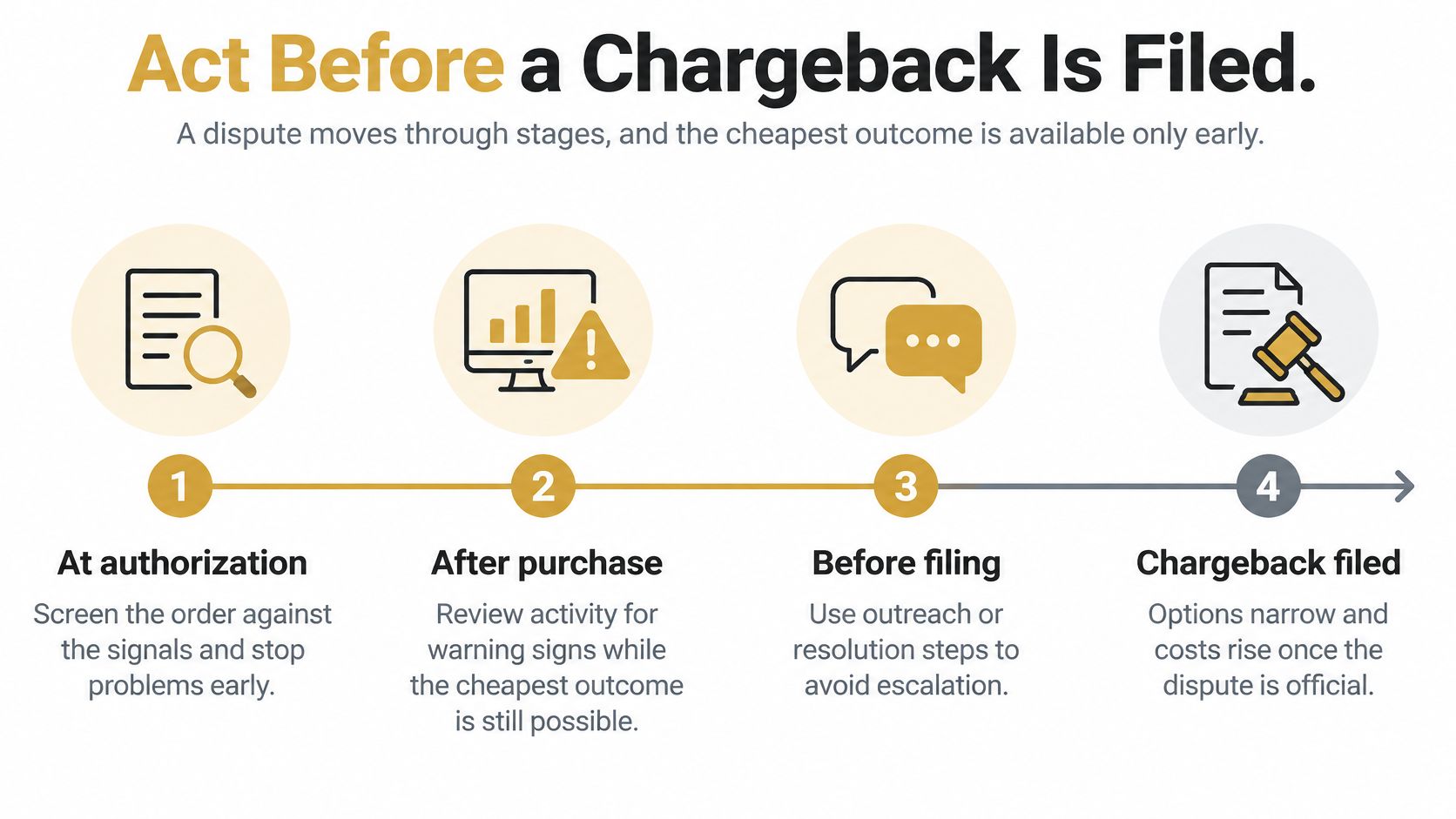
A customer complaint, a pre-chargeback alert and a formal chargeback are different operational events. Earlier intervention generally leaves more options available, but no alert workflow guarantees that a dispute can still be prevented.
Sift's disputes report projects worldwide chargeback losses to rise from $33.79 billion in 2025 to $41.69 billion in 2028, and reports that average chargeback rates reached 0.26% in Q3 2025, up 53% from Q1. For merchants, the practical response is to assign responsibility before an urgent case arrives.
Assign an action at each stage
At authorization, screen the order. Route concerning signal combinations to review. A successful authorization doesn't resolve questions about who is placing the order or whether the account has been compromised.
Before shipment, resolve open mismatches. Confirm the address and delivery method through an established contact channel. Hold the order when material questions remain, and give the reviewer authority to release or cancel it.
When a service failure appears, offer the remedy. Don't wait for the buyer to discover a lost parcel or unavailable product. Contact them with a concrete reshipment, replacement or refund option while ordinary customer service can still resolve the issue.
When the customer complains, reply the same day where operationally possible. Record the reason in the customer's terms and give a clear next action. An acknowledgment without an owner or resolution date can leave the customer looking to their issuer for help.
When a pre-chargeback alert arrives, check its deadline and status. Decide whether the authorized refund route is appropriate, verify whether a refund already exists and record completion. Avoid duplicate refunds, and don't assume every alert has the same response window.
After a formal chargeback is filed, follow the dispute workflow. Use representment only when the evidence and economics support it. Check the processor's instructions before issuing a separate refund so the merchant doesn't reimburse the same transaction twice.
Keep prevention and recovery separate
Chargeback fighting is a recovery decision after filing, not a substitute for resolving a complaint beforehand. Your team needs different queues and approval rules for each.
Refunding isn't always cheaper than contesting. Product margin, alert costs, dispute fees, likely recovery and account-monitoring exposure can change the decision. A universal refund rule ignores those differences.
Give every stage a named owner and a backup. Checkout review might belong to payments operations, delivery failures to support and formal responses to a dispute specialist, but an urgent case should never sit between teams because nobody can approve the next action.
Set Up Your High Risk Customer Review Process
A useful review process gives staff a repeatable decision, not just another dashboard. Start with rules your team can explain and evidence it can retrieve without searching disconnected inboxes.
- Write a rule for each warning signal. Specify which combinations trigger manual review and which require an immediate security response. Include what clears the flag.
- Name the refund approver. Give that person a backup and authority to act within the applicable alert deadline.
- Build an evidence checklist. Include transaction history, fulfillment proof, cancellation logs and support records. Store the relevant policy version with the order.
- Set product-line thresholds. Base refund and contest decisions on contribution margin, applicable fees, evidence strength and recovery costs.
- Review false positives monthly. Examine legitimate orders held or declined, identify unnecessary friction and adjust the rules.
Fix causes as well as individual cases
Use customer feedback to identify confusing offers and recurring service faults. For supplement merchants, Yuve's guide to understanding feedback from supplement customers provides context for turning complaints into questions about the purchase experience rather than treating every complaint as a risk event.
Disputely provides chargeback alerts to support timely review, while all refund decisions remain the merchant's responsibility and we initiate refunds or related service-provider communications only with the merchant's authorization.
Choose the first segment you'll test and decide who approves its refunds. Start where the evidence is accessible and the decision is reversible, then expand after reviewers can explain their outcomes consistently.
Disputely offers chargeback alerts and dispute-prevention support for ecommerce merchants managing high risk customer activity. Visit Disputely to discuss a workflow that separates preventable disputes from cases worth contesting, while keeping refund authorization under your control.


