
Hold Rel Mem Cr Meaning on Your Bank Statement
HOLD REL MEM CR is generally a hold-release memo credit: previously restricted deposit funds becoming available, not a new purchase, fee, or chargeback. It usually records the lifting of a deposit hold rather than money arriving from a new payment.
You might be checking your banking app before paying a bill and notice this unfamiliar line beside a credit. You recognize the recent check deposit, but the extra entry makes it look as though the bank has credited you again. Before you move the money, the useful question is whether the bank has made the original deposit available, not whether the abbreviation looks positive.
What Hold Rel Mem Cr Means on a Statement
Hold-release memo credit is the plain-language translation. A bank records a deposit, temporarily restricts access to some or all of it, and then records the removal of that restriction.
The Sniffies Meaning explanation of HOLD REL MEM CR connects the label with released deposit holds, especially check deposits, while noting that it isn't a universal banking standard. Your bank's transaction details remain important because institutions can display their internal accounting differently.
How to read HOLD REL MEM CR and nearby lines
The individual pieces help you recognize the entry. The surrounding transactions help you understand what happened.
| Line or piece | Plain reading | Balance effect | What it is not |
|---|---|---|---|
| HOLD | Temporary restriction on deposited funds | Cuts available balance while posted balance may already include the deposit | A permanent fee |
| REL | Release of that restriction | Restores the released amount to available balance | A brand-new deposit |
| MEM | Internal memo entry | Records the bank's hold accounting | A card purchase or merchant descriptor |
| CR | Credit | Identifies the credit side of the entry | A debit or withdrawal |
| Original deposit credit | Check, cash, or ACH first posted | Raises posted balance | The later release line |
| Hold memo debit | Restriction applied after the deposit | Lowers available balance | A bill from a merchant |
| HOLD REL MEM CR | Restriction lifted | Available balance increases by the released amount, subject to other activity | Proof a dispute is closed |
Read the full phrase rather than treating CR as a promise of extra money. A credit can offset an earlier restriction without representing another payment into your account.
Likewise, MEM describes the bank's recordkeeping. It doesn't identify a store, subscription, or person who charged you.
What the entry tells you today
The most useful context is the deposit immediately associated with the hold. Open the transaction details and look for a check deposit, mobile deposit record, or reference that connects the release to an earlier credit.
A matching hold memo debit can make the sequence easier to recognize. That debit may have restricted what you could withdraw without representing money paid to anyone.
Practical rule: Read HOLD REL MEM CR as a change in access to an existing deposit, not as a separate source of income.
Don't expect every bank to show every stage as a separate statement line. One app may display a hold in the transaction feed; another may put it in a deposit-details screen or an availability notice.
The reasonable conclusion is narrow: the bank usually recorded the release of previously restricted funds. It's generally not a charge you need to pay, and the amount shouldn't automatically be counted as another deposit.
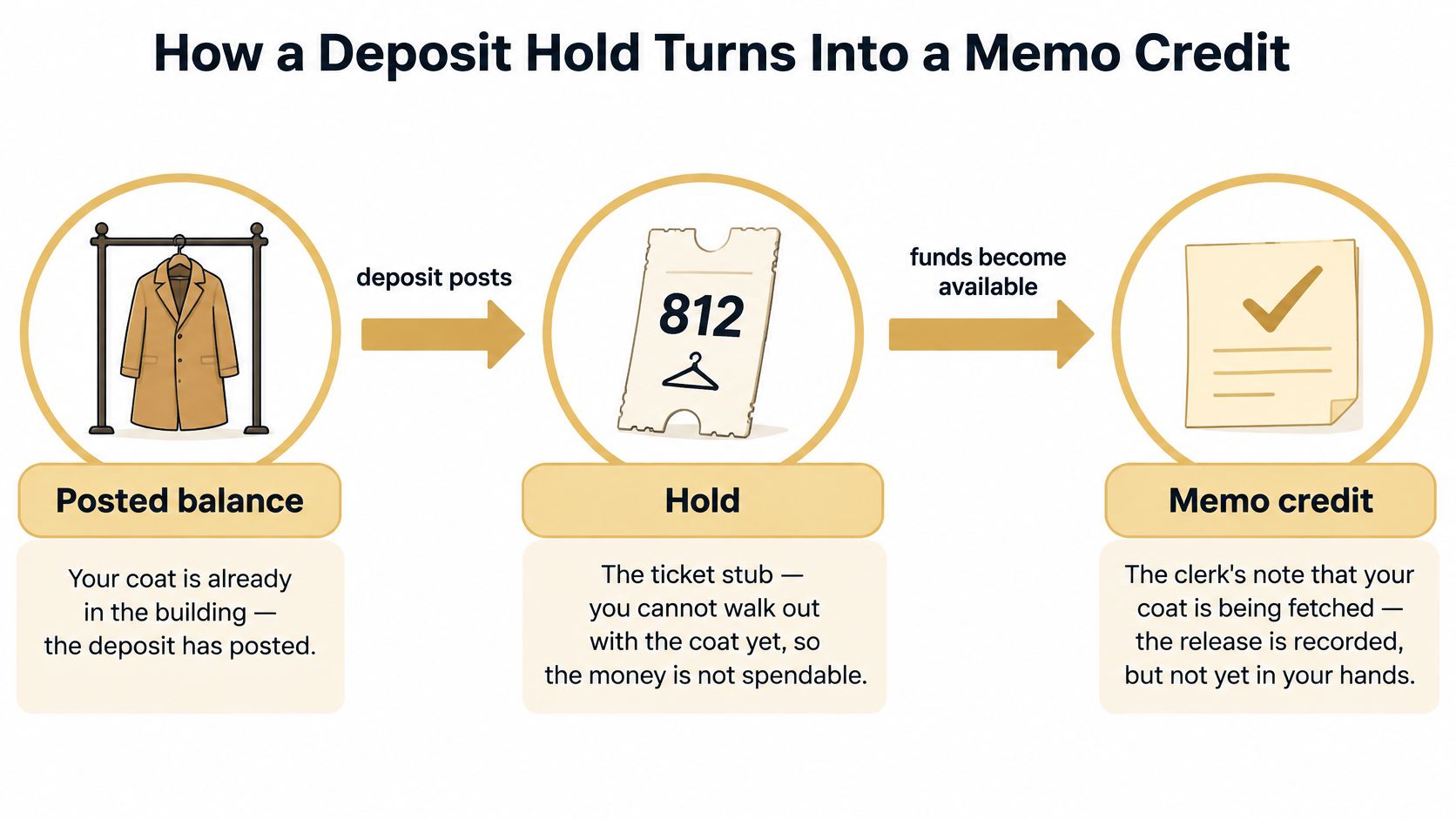
How a Deposit Hold Turns Into a Memo Credit
Think of a coat check. Your coat is already in the building, but you can't take it away while the clerk is still holding it. The deposit is similar: the bank can acknowledge it in your account before making all of it usable.
The ticket represents the restriction, and the release record represents the clerk processing the return. The final check is whether you have access, not whether a note says the release has been recorded.
Follow a check through the account
Say you deposit a personal check through your banking app. The app shows the deposit as received, and the bank adds it to the account's posted records.
The bank then restricts access while it processes the item. A check can still be returned unpaid, so acknowledging the deposit and permitting a withdrawal aren't necessarily the same event.
When the bank releases the restriction, it may display HOLD REL MEM CR or another release description. You haven't deposited the check again. The bank has changed how much of the original deposit you can use.
The sequence is:
- Deposit recorded: The bank acknowledges the incoming item.
- Access restricted: A hold prevents you from using the held portion.
- Release recorded: The bank removes some or all of that restriction.
- Availability confirmed: The account shows what you can currently spend or withdraw.
Posted balance and available balance answer different questions
Your posted balance reflects transactions the bank has recorded. Your available balance reflects what the bank currently makes accessible, taking applicable holds and other account activity into account.
That's why an account can look comfortably funded while a withdrawal still exceeds the available amount. During a deposit hold, the difference isn't necessarily missing money. It can be money recorded but not yet accessible.
Don't predict a release date from the abbreviation. Use the bank's deposit notice or hold details, which are more useful than assuming every check follows the same timetable.
Also, a deposited-check hold isn't the same event as a merchant authorization on a card. If your unfamiliar entry concerns a hotel, fuel station, or other pending card transaction, the explanation of holds on credit cards addresses that separate process.
For a deposit release, compare posted and available balances together. The posted figure tells you what has been recorded; the available figure is the practical starting point for a spending decision.
Statement Patterns That Match This Credit
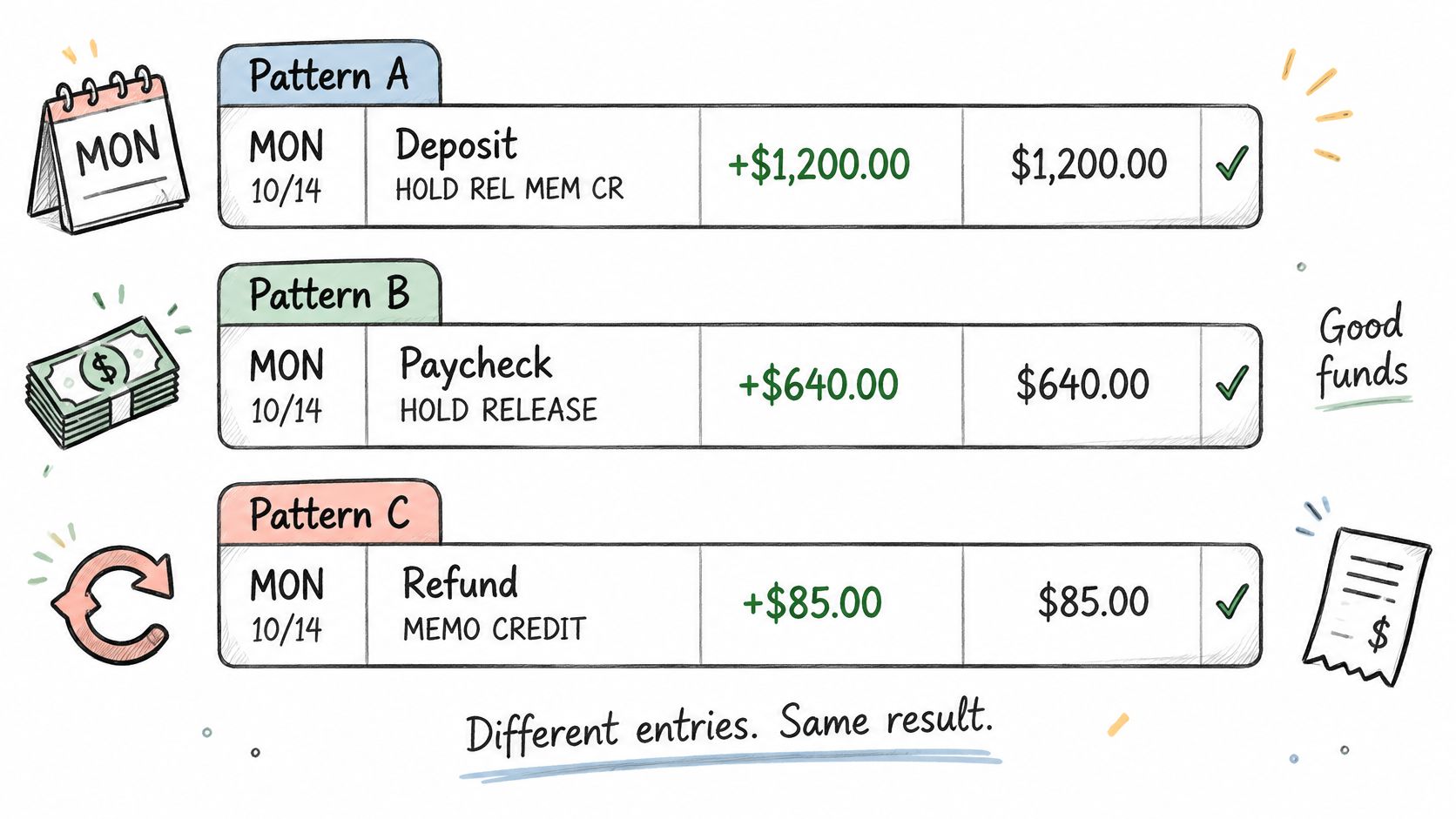
A recognizable sequence is more informative than an isolated abbreviation. These are hypothetical ledger examples, not promises about amounts or release schedules at your bank.
Pattern A with a full release
Suppose you deposit a $1,200 personal check on Monday. Your bank displays the following sequence:
| Example day | Ledger entry | Example amount |
|---|---|---|
| Monday | Check deposit credit | $1,200 |
| Monday | Hold memo debit | $1,200 |
| Thursday | HOLD REL MEM CR | $1,200 |
Assuming no unrelated account activity, available funds increase by the released amount on Thursday. There's still only one underlying check deposit, even though the screen contains both an original credit and a release credit.
Pattern B with part of the hold remaining
Now suppose a $3,000 mobile deposit includes a $2,000 hold. A later HOLD REL MEM CR entry releases $1,000, leaving $1,000 restricted.
| Example stage | What you see |
|---|---|
| Deposit day | Mobile deposit recorded, with part held |
| Release day | Memo credit removes part of the restriction |
| Following business day | Remaining portion releases in this hypothetical scenario |
The smaller release isn't automatically an error. Open the hold details before assuming the entire deposit is available.
Pattern C with no matching deposit
Suppose a $75 memo credit appears, but you can't find a related deposit in the prior week. That's an unresolved match, not evidence of unexpected income.
Ask the bank to identify the underlying item. An amount that looks small or familiar still needs a transaction-level explanation.
A release that matches a deposit is understandable. A credit with no identifiable deposit needs clarification before you rely on it.
Other sequences can complicate the picture. A weekend deposit might show its release on a subsequent business morning, while a returned check could produce a later debit after an earlier release.
A business checking account can also use deposit-hold language without referring to a card-sale refund. Identify whether your screen resembles a full release, a partial release, or an unmatched entry before moving funds.
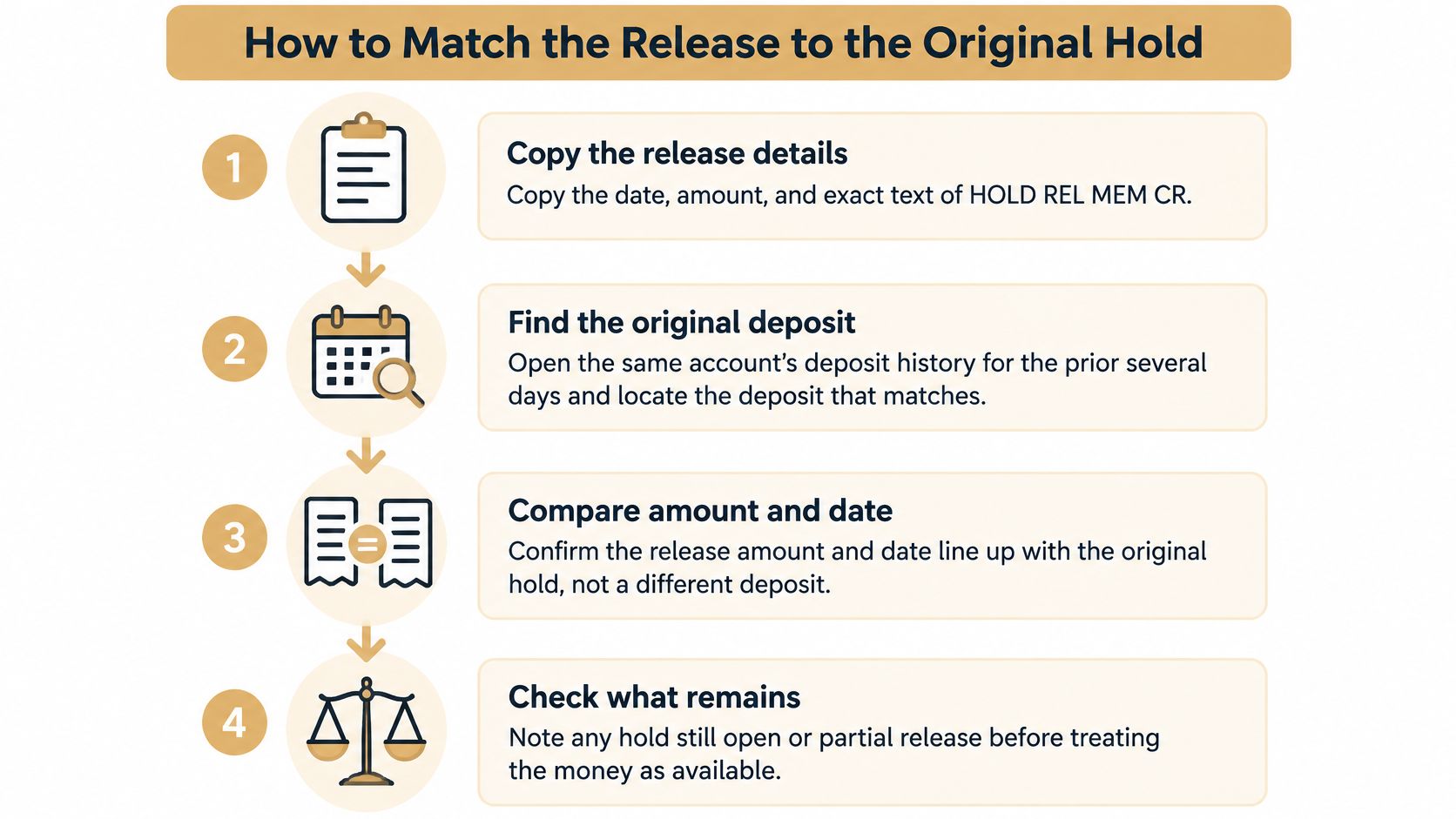
How to Match the Release to the Original Hold
Use the account's transaction history, deposit receipt, and hold details together. A spreadsheet or a simple note is enough, provided you keep the release, deposit, and restriction separate.
Make a complete reconciliation pass
Copy the release details. Record the posting date, amount, and exact HOLD REL MEM CR description. Save the transaction reference if the app provides one, so you can identify the same entry when speaking to the bank.
Find the original deposit. Open deposit history for the same account and review the preceding business days. A matching deposit may equal the release or exceed it when only part of the deposit was held.
Locate the restriction. Look between the deposit and release for a hold memo debit, pending hold, or deposit-availability notice. The confirming record should connect the restricted funds to that deposit, not merely share a similar date.
Compare the balance change. Check available funds before and after the release, accounting for purchases, withdrawals, and other transactions occurring in between. A release should make the released portion accessible without requiring another deposit receipt.
Explain any difference. Check for partial releases, deposits grouped together, or another hold that remains open. Don't force a match just because two entries have similar descriptions.
Ask the bank about an unmatched entry. If you can't identify the deposit or restriction, leave the unexplained amount untouched. Give the bank the posting date, amount, and exact description, and ask which deposit or adjustment it references.
Check transaction history rather than today's balance alone
Your current balance may include activity that happened after the release. A purchase made around the same time can obscure the increase, so don't require the account's total to have risen by the exact memo amount.
Instead, compare the individual entries in order. If the banking app doesn't preserve historical available balances, ask support to confirm whether the release increased availability and whether any restriction remains.
For business bookkeeping, transaction reconciliation helps separate actual incoming payments from adjustments that merely change access to funds. Keep the original deposit as the payment record and the memo entry as supporting bank activity.
A useful support request is direct: ask the representative to identify the original deposit, explain the release amount, and confirm any remaining hold. Share screenshots through the bank's secure channel rather than posting account details publicly.
Your match test is an earlier deposit, a related restriction, a consistent released amount, and confirmed availability. If a piece is missing, label the entry unresolved instead of guessing.
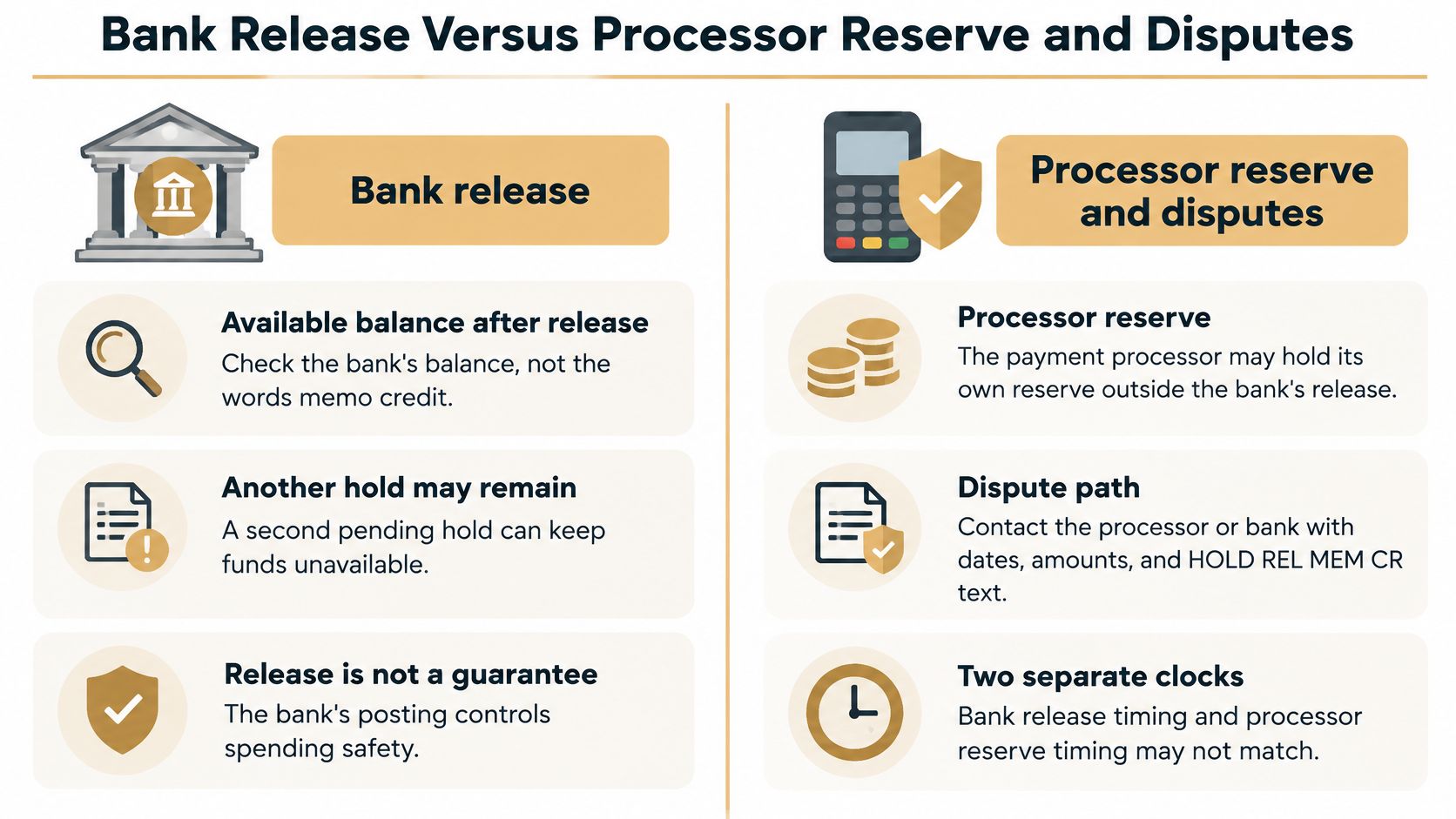
Bank Release Versus Processor Reserve and Disputes
No, a bank hold release doesn't prove a merchant payout is free of processor reserves. No, it doesn't prove a dispute has been resolved. Those conclusions require records from the processor or dispute system, not just a checking-account entry.
A merchant can receive a deposit-hold release while the processor continues withholding other payouts. The processor can also keep accepting payments while restricting payouts under its reserve terms.
What a released credit does and does not settle
| Situation | Funds you can use | Dispute status | What to check |
|---|---|---|---|
| HOLD REL MEM CR after a check hold | Usually the released amount, if available balance rose | Unchanged | Posted versus available balance |
| Hold still pending on part of the deposit | Only the unheld portion | Unchanged | Remaining hold amount and release date |
| Processor payout reserve | Bank funds may be available while other payouts remain withheld | Unchanged by the bank memo | Processor reserve terms and payout status |
| Open dispute alert before a chargeback | Sale funds may already have settled | Follow the alert's resolution requirements | Open alert, refund, or case |
| Filed chargeback | Separate from this deposit line | Follow the case through its recorded outcome | Chargeback case, not the memo label |
Don't interpret improved access to bank funds as evidence that dispute pressure has declined. Mastercard's 2025 State of Chargebacks report projected global chargeback volume to rise 24% between 2025 and 2028.
Chargeback metrics use the applicable definitions for settled transactions, disputes, or fraud reports. A deposit memo on a checking ledger doesn't, by itself, change those metrics.
Use separate checks for bank access and merchant exposure
Before paying a supplier from a recently released amount, verify:
- Bank availability: Compare posted and available funds, including any remaining restriction.
- Deposit identity: Identify the original deposit behind the release.
- Processor payout status: Confirm whether the relevant payout is paid, pending, or withheld.
- Open cases: Review alerts, refunds, and chargebacks separately.
A merchant account reserve is a processor-level restriction. Its release conditions aren't established by the bank lifting a hold on a deposit that already reached checking.
For a merchant, the right conclusion may be that cash is accessible today while a separate reserve or dispute obligation remains. Record both facts rather than treating either system as the complete account of your funds.
Wrong Readings and What to Do With the Funds
Treating HOLD REL MEM CR as a new merchant charge can send you down the wrong path. You might contact a store that had nothing to do with the entry or begin a purchase dispute without identifying an actual purchase.
A card transaction typically has its own merchant information, although descriptors aren't always easy to recognize. This bank abbreviation alone isn't a reason to dispute a store charge.
Four readings to avoid
- A surprise purchase: Look for a separate purchase record and merchant descriptor before contacting a seller. A hold-release memo is generally bank accounting, not a merchant billing description.
- A second payment: The original deposit has its own record. Counting the release again can overstate income and make your bookkeeping disagree with the actual payments received.
- A bank fee: A fee normally appears as a debit or fee entry. Don't classify a release credit as an expense just because the wording is unfamiliar.
- A won chargeback or released processor reserve: Confirm those outcomes in the processor's payout or case records. A checking-account memo doesn't establish either result.
For bookkeeping, preserve the relationship between the deposit and its release. If accounting software imports both entries as income, review the classification before accepting the suggested match.
The objective isn't to delete a bank record. It's to avoid recognizing the same underlying receipt twice.
Choose your next action from the evidence
When the match is complete, the deposit is identified, the released portion is available, and no related hold remains, use the bank's available balance as your spending limit. Account for upcoming payments you've authorized but that the bank hasn't yet reflected.
When something doesn't match, don't rely on the unexplained amount. Ask the bank to identify it using the posting date, amount, transaction reference, and a screenshot from the account.
When a later debit reverses the deposit, investigate that debit before making another transfer. An earlier release doesn't explain away a subsequent returned-item adjustment.
Before moving money: Confirm what the bank makes available and what obligations still exist outside the bank account.
If you receive card payouts, keep a separate operational check for processor reserves and open customer cases. Don't tell a customer, supplier, or colleague that a payout is clear solely because this memo appeared.
At Disputely, we don't hold or control merchant or customer funds. Early dispute alerts are a separate process from a bank's deposit-hold accounting, and they don't turn a memo credit into confirmation that a reserve has ended.
Open the release details now, identify the deposit, and check the remaining hold status. If those records don't agree, send the bank a precise question before using the unexplained funds.
Disputely offers dispute alerts through Ethoca, Verifi RDR, and CDRN, helping merchants address customer disputes separately from bank deposit holds. Visit Disputely to explore alert handling for your card payments while keeping bank availability, processor payouts, and dispute outcomes reconciled separately.


