
Mastercard Dispute Charge: Merchant Response Guide
A customer says they don't recognize a charge. Your support team finds the order, confirms it shipped, and drafts a reply. Then the processor shows a Mastercard chargeback, not a refund request. At that point, the practical question isn't just whether the sale was legitimate. It's whether you can answer the stated reason, meet the processor's deadline, and justify the cost of contesting it.
For ecommerce and subscription teams, a Mastercard dispute charge is a merchant-response problem with distinct paths: resolve an early alert, refund a clear loss, or prepare a reason-specific case through your processor. Knowing which path fits can save time and avoid spending heavily to defend a charge that should have been refunded.
What a Mastercard Dispute Charge Actually Does
The dispute begins outside your store. A cardholder contacts their issuer, and the issuer decides whether to initiate a chargeback. Your acquiring bank can't start one on your behalf. Mastercard describes chargebacks as a rules-based process for assigning financial responsibility, not a request for the merchant to refund a customer. Its chargebacks guide sets out the stages and the parties responsible for them.
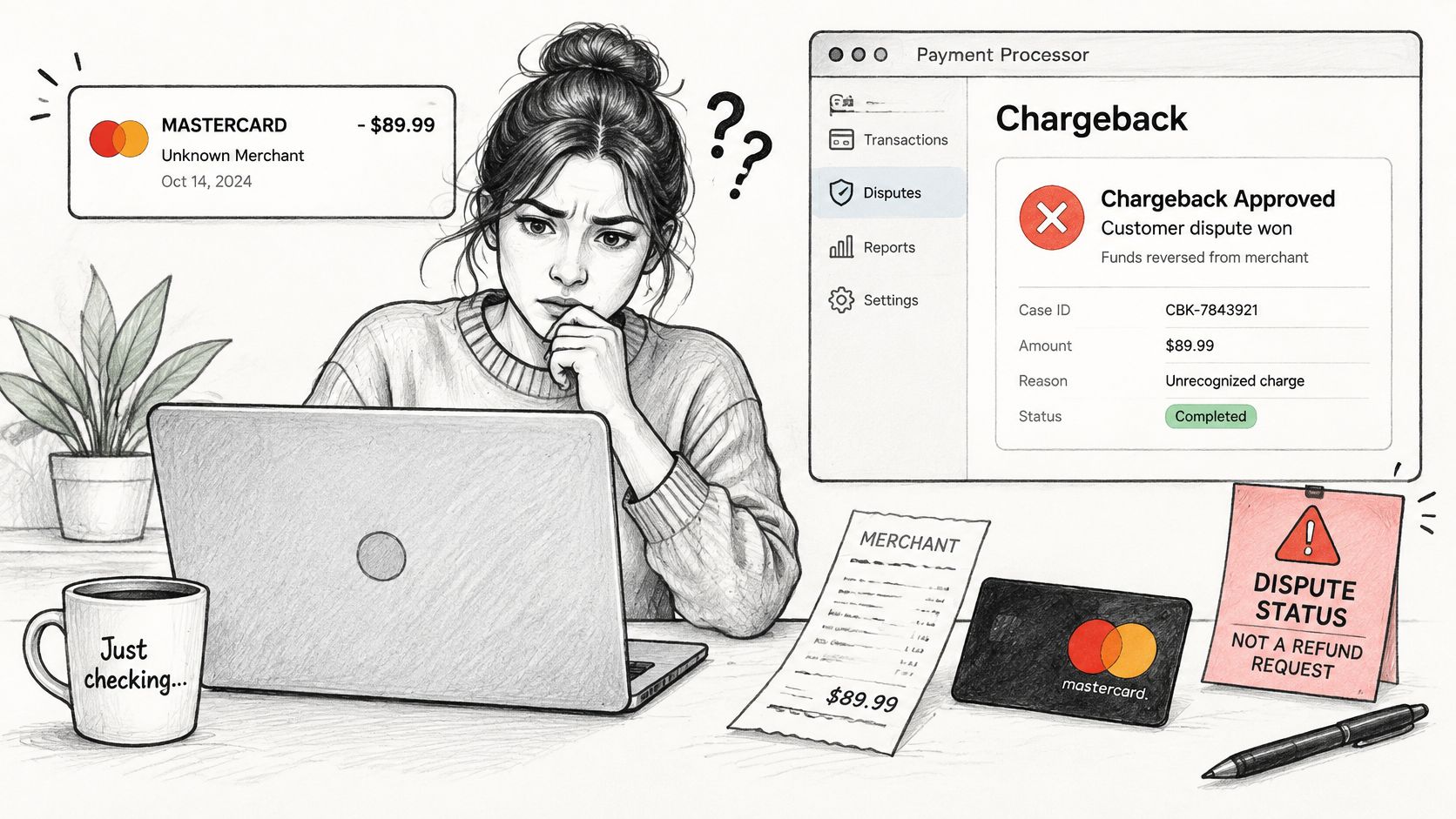
Consider a typical DTC order. A customer doesn't recognize the billing descriptor, contacts their issuing bank, and disputes the transaction. In the first cycle, the issuer returns the transaction to the acquirer with a reason for the dispute and, where required, supporting documents. Mastercard then moves the funds by crediting the issuer and debiting the acquirer. The funds have shifted before your team has finished investigating the order.
The acquirer can accept the chargeback or send a second presentment: a response that rejects it and provides evidence relevant to the stated reason. A tracking record may answer a claim that goods never arrived; it won't necessarily answer a claim that the customer didn't authorize the purchase. If the issuer rejects the response, the case may move to pre-arbitration and then arbitration, where Mastercard makes the final decision. One clearing transaction can also receive multiple partial chargebacks, but their combined amount can't exceed the original transaction amount.
The operating milestone is the first chargeback. By then, funds have moved away from the acquirer, and your response needs to go through your processor's dispute workflow.
That's why a chargeback shouldn't be handled like an ordinary support ticket. The reason code, evidence requirements, response route, and escalation stages all matter. If the charge affects a close, a clear process for month-end chargeback reconciliation helps finance match processor activity to the underlying order and track whether a debit was accepted or contested.
Keep the broader chargeback rate and account risk in view, too. A single case needs a reason-specific decision; a pattern of cases calls for a separate review of checkout clarity, fulfillment, billing descriptors, and cancellation handling.
Mastercard Dispute Deadlines Merchants Must Hit
| Stage | Who acts | Deadline | What a miss means |
|---|---|---|---|
| Merchant decision after notice | Merchant through acquirer | Commonly 10–35 days; network often 20–45 days after notice | No challenge, even if the sale was valid |
| Second presentment | Acquirer | 45 calendar days from chargeback processing date | Chargeback stands |
| Arbitration filing | Issuer | 45 calendar days from second presentment processing date | Case doesn't reach Mastercard's final ruling |
| Full dispute path | Issuer, acquirer, Mastercard | Up to 120 days | Liability and operations stay open for months |
Use the processor's due date whenever it's earlier than the network deadline. The merchant's window is the one your team has to act within: Mastercard says acquirers commonly give merchants an average of 10–35 days to decide whether to challenge a chargeback, while network deadlines are typically 20–45 days after the merchant is notified, according to its merchant guidance on disputing chargebacks. The processor may require your evidence well before the network's outer limit so it has time to review and submit the response.
The later clocks belong to the institutions handling the case, but they still matter to your operation. An acquirer generally has 45 calendar days from the chargeback's processing date to submit a second presentment. An issuer generally has 45 calendar days from the second presentment's processing date to file for arbitration. If one of those parties misses its deadline, the case doesn't advance through that stage.
Build the response calendar from notice day
The full process can remain open for up to 120 days, depending on the transaction, evidence, and escalation path. That means a case can consume staff time and leave liability unresolved well after the customer's original contact. Don't confuse a long overall process with a long merchant response window.
The evidence that matters depends on the reason. Pull transaction records, fulfillment details, customer messages, and authentication information as soon as the notice arrives. If the team waits for a meeting to decide who owns the case, it may lose time needed to find records or get them into the acquirer's format.
For ecommerce and subscription teams, alerts are most useful before a formal chargeback is filed or while the response window is open. An alert received after arbitration starts can't replace a timely second presentment. Set the processor's due date in your task system on the day the notice comes in, assign one owner, and begin evidence collection immediately.
Treat day one as evidence day, not discussion day. A legitimate transaction can still become uncontestable if the response misses the processor's deadline.
How Merchants Answer a Mastercard Dispute
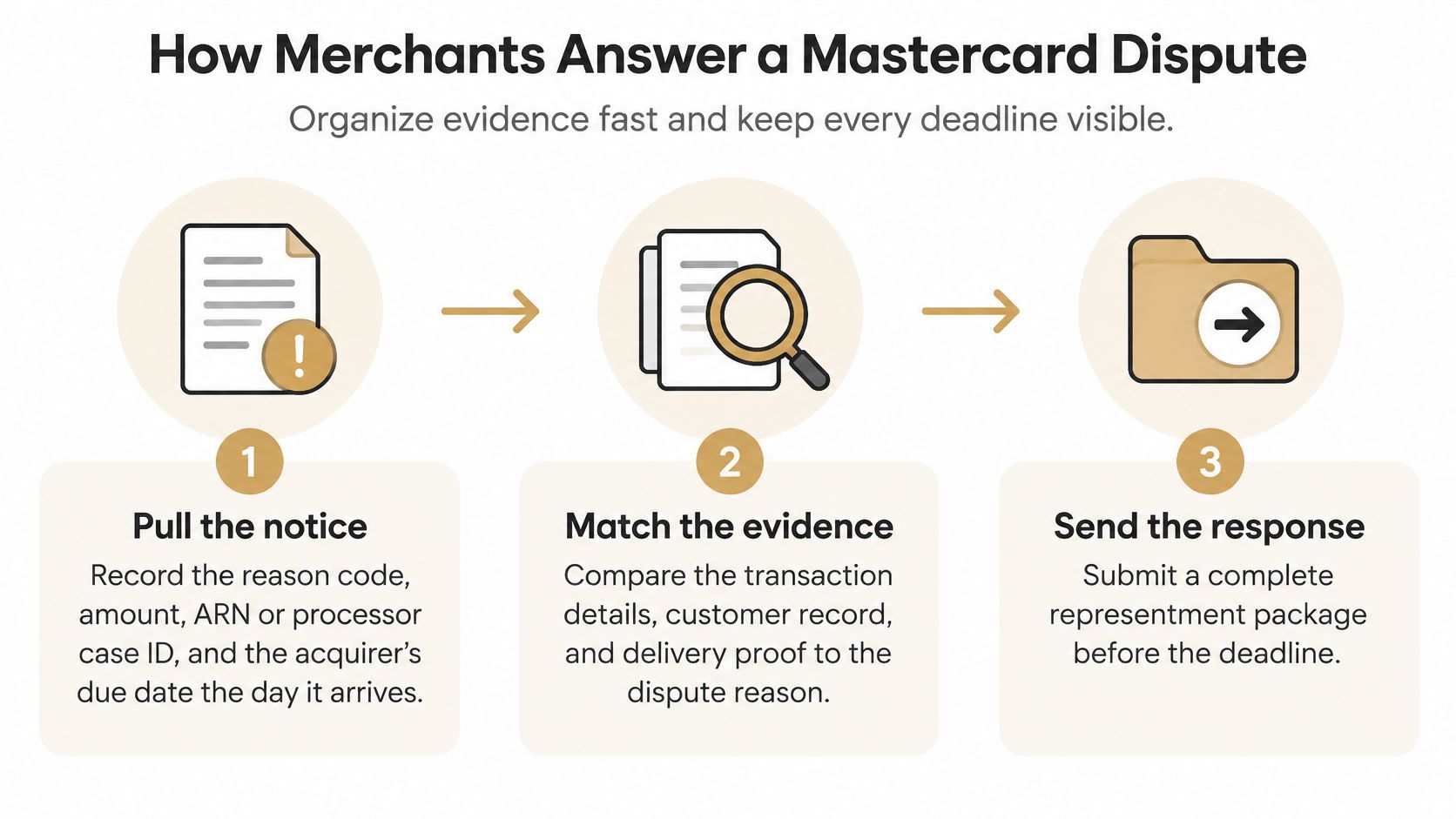
A useful response starts with the notice, not a prewritten defence. Follow this sequence so the case file stays connected to the reason the issuer supplied.
Capture the case details. Open the processor notice on arrival. Record the reason code, disputed amount, ARN or processor case ID, and the acquirer's due date. Save the notice with the case so the person preparing evidence can see the original allegation.
Match the dispute to the order. Search by cardholder details, billing descriptor, amount, and transaction date. Check whether it's a partial chargeback rather than assuming the full sale is in dispute. Decide whether to accept the loss or contest it before asking other teams to build a file.
Choose evidence that answers the reason. Pull the relevant order, fulfillment, customer communication, and authentication records. For ecommerce transactions, that may include 3-D Secure results, AVS information, and prior undisputed orders. Don't attach a stack of unrelated documents in the hope that volume will persuade the reviewer.
Submit through the processor or acquirer. Use the response channel tied to the case and keep the submission confirmation. Don't email the cardholder to try to reverse a chargeback; customer communication may help explain what happened, but the formal response belongs in the processor workflow.
Reassess before escalation. If the issuer rejects the second presentment, decide whether pre-arbitration is worth the added work and cost. Don't keep adding arguments that weren't relevant to the original reason. Mastercard makes the final determination at arbitration.
The point of the workflow is to create a concise file with a clear connection between the claim and the evidence. The table below is a practical match, not a guarantee of a particular outcome.
| Dispute reason | Evidence to attach | Weak file looks like |
|---|---|---|
| Unauthorized or fraud | 3-D Secure, AVS, device or IP data, prior undisputed orders | A receipt with no authentication |
| Goods not received | Carrier tracking, delivery scan, signature or pickup proof | A shipping label with no delivery event |
| Not as described | Product page, description, return policy, customer messages | A generic refund policy screenshot |
| Credit not processed | Refund date, amount, processor reference | An internal note that a refund was promised |
| Cardholder does not recognize | Billing descriptor, receipt email, order details | The raw processor descriptor alone |
Say a $74 DTC order is disputed as not received, but carrier tracking shows delivery. The useful file is the tracking result and delivery scan, with any available signature or pickup record. A long narrative about the warehouse's normal packing procedure won't substitute for proof tied to the disputed shipment.
A reliable records policy matters because order confirmations, shipping events, policies, and support messages may sit in different systems. Establishing how to manage ecommerce records can help teams keep the records they need accessible when a case arrives. For a closer look at contesting rather than accepting a case, review the chargeback fighting process.
The deciding test is simple: if a piece of evidence doesn't answer the stated reason, it doesn't strengthen the response. Submit the smallest complete file that proves the relevant point, and confirm that the processor accepted it before the deadline.
When Recurring Billing Changes the Case
Two subscription disputes can look identical in a processor dashboard. One customer canceled in writing before renewal but was billed anyway. Another agreed to ongoing billing, received a renewal notice, and later says they don't remember consenting. Those cases call for different decisions, even if both arrive with a claim that the recurring transaction wasn't understood.
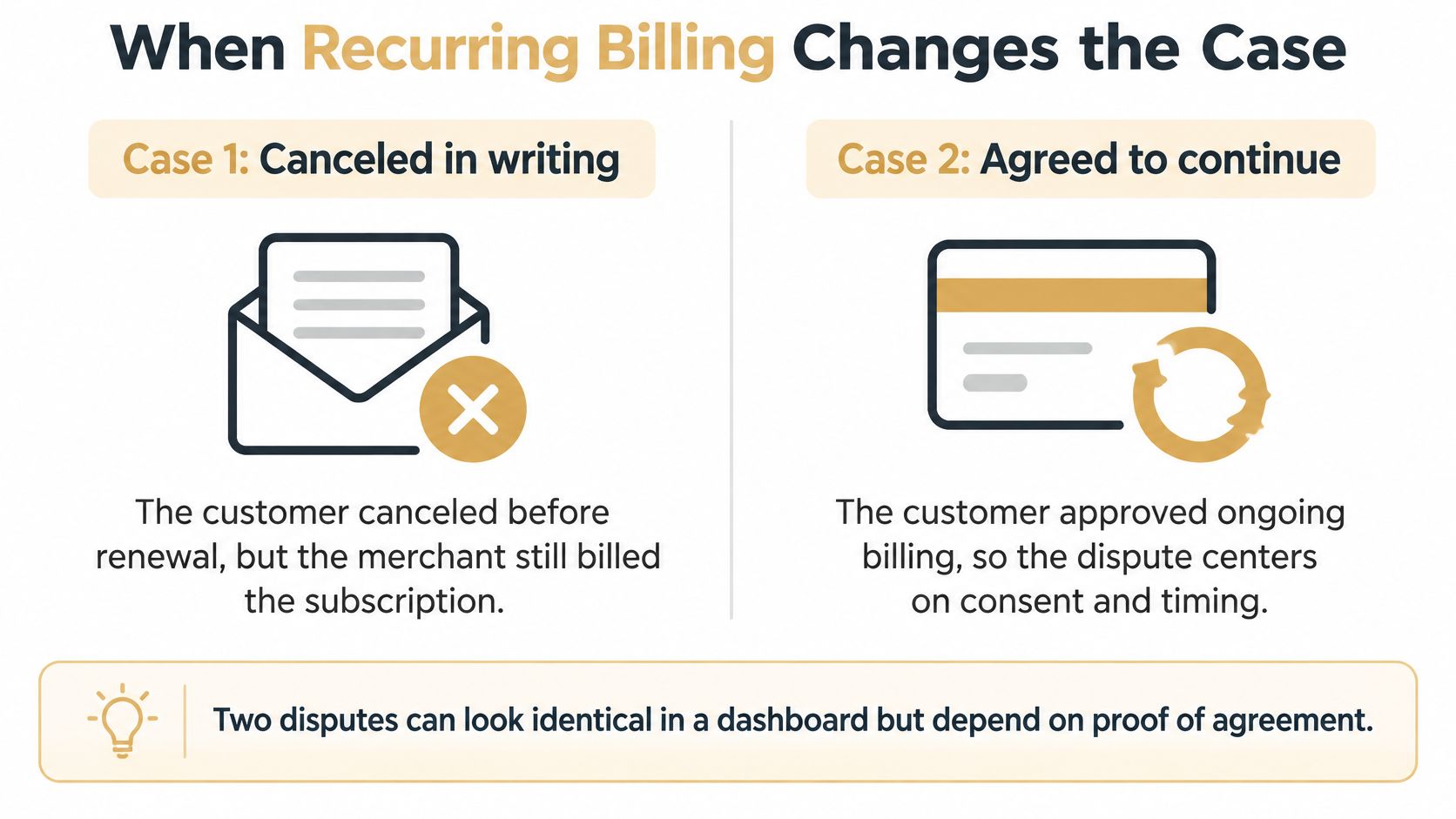
Mastercard describes a recurring transaction as continuous billing without a specified end date. A cardholder may dispute after telling the merchant to cancel, or because they didn't understand that billing would continue. For the first chargeback involving a canceled recurring payment, the issuer may require supporting documentation such as a cardholder letter, email, or expedited billing dispute form. The Mastercard chargeback guide makes clear why a receipt alone may not settle a recurring-billing case.
Keep four records separate
Store initial consent, renewal disclosures, the cancellation trail, and the refund decision as distinct parts of the customer record. That makes it easier to show whether the customer agreed to continuing billing, what they were told about renewal, when they asked to cancel, and how the merchant responded. Retain timestamps and confirmation messages, not just a support note saying “canceled.”
Suppose a SaaS customer submits a cancellation request at 4:12 p.m., receives no confirmation, and is charged at 6:00 p.m. The billing system's record of a successful renewal doesn't answer the central issue: the customer requested cancellation before the charge. If the timestamp confirms that sequence, an immediate refund is the sensible response. A thicker evidence packet won't fix a charge that posted after a clear cancellation.
The opposite case deserves a closer look. The customer agreed to continuous billing, received a pre-renewal notice, and used the service after renewal, but then says the charge was unfamiliar. Consent records, the notice, and post-renewal usage may support a representment, provided they answer the specific reason and the response is still timely. Usage alone doesn't prove every element of consent, so keep the underlying agreement and billing terms with the activity record.
The operational sort should happen before anyone opens a response template: canceled before billing, unrecognized renewal, or alleged unauthorized use. Refund the first when the timestamp confirms the cancellation preceded the charge. Assess the other two against the consent and authentication record instead of treating every subscription complaint as fraud.
How to Stop the Dispute Before Escalation
An early alert and a chargeback response aren't the same task. A pre-chargeback collaboration alert can signal that an issuer is handling a cardholder's concern before a formal chargeback is filed. The merchant may be able to resolve the issue with a refund at that stage. Once a chargeback exists, the work shifts to preparing a reason-specific response through the acquirer.
Mastercard CDRN-style collaboration alerts and Ethoca-style early warnings can give the merchant an opportunity to review the transaction and act before escalation. They aren't evidence packages, and they don't replace representment. Treat the alert as a prompt to make a quick decision: identify the order, check the customer's history and request, then refund a clear loss or resolve an error where possible.
Make prevention operational
Make the descriptor recognizable. Use a billing name that matches the store or brand the customer saw at checkout. If the statement shows a parent-company name customers won't recognize, a legitimate purchase can look unfamiliar.
Set expectations before billing. Send an order receipt promptly. For subscriptions, make renewal terms clear at signup and send a renewal notice before rebilling so the customer has a chance to recognize the charge and contact support.
Close the cancellation loop. Send a timestamped confirmation when a cancellation is completed. Make sure the billing system applies it before the next renewal rather than relying on a support agent to remember a separate manual step.
Refund a clear loss quickly. A customer who canceled before renewal, a shipment that never went out, or a credit already promised generally calls for a straightforward resolution, not an elaborate defence. Mastercard reported that approximately 20% of disputes resulted from first-party fraud in 2025, based on research involving merchants and issuers, in its discussion of first-party fraud. That finding is a reason to evaluate cases carefully, not to presume that every customer is acting improperly.
A repeatable public-response process also helps when complaints appear outside the support queue. Teams that need to coordinate replies to visible customer complaints can use a practical guide to handling public ad complaints, then route any payment issue to the same case owner who can check the order and transaction.
Refund the alert you'd lose, and save the evidence effort for the reason you can actually answer.
For teams managing Shopify disputes, a defined Shopify chargeback protection workflow can help connect alerts and response work to the order record. High-volume merchants and businesses with risk-sensitive offers, such as supplements, travel, and continuity products, should also watch whether repeated disputes are prompting processor scrutiny. The practical goal isn't to contest every alert; it's to resolve preventable problems early and reserve representment effort for cases with evidence that fits the claim.
Decide to Refund or Represent the Charge
A merchant doesn't win by contesting everything. Refund when the customer canceled before a recurring bill, the goods never shipped, a credit was already promised, or the evidence doesn't answer the reason. Represent when authentication, delivery, or a clear consent trail matches the claim and the processor's response window remains open.
| Case | Action | Evidence test |
|---|---|---|
| Canceled before a recurring bill | Refund now | Cancellation timestamp before the renewal charge |
| Goods never shipped | Refund now | No carrier delivery event |
| Credit already promised | Refund now | Refund not yet processed |
| Evidence doesn't answer the reason | Refund now | Reason code unmatched by the file |
| Authentication or delivery matches the reason | Represent | 3-D Secure, tracking, or delivery proof |
| Clear consent trail and post-renewal usage | Represent | Consent, pre-renewal notice, usage record |
The cost of a poor decision isn't limited to the disputed amount. Mastercard reported that U.S. merchants incurred an average of $128 per chargeback in 2025, comprising $82 in internal costs and $46 in third-party fees, in its analysis of chargeback costs. That's a reason to compare the likely recovery with the cost of preparing and escalating a weak case.
Make the decision the same day the case is triaged: label it refund or represent, set the acquirer's due date, and either issue the credit or submit evidence matched to the reason. Disputely's Chargeback Mitigation service automatically compiles, submits, and tracks evidence for disputes. Outcomes still depend on merchant practices, issuer behavior, processor risk models, and network rules, so prevention and recovery aren't guaranteed.
Connect your processor, define refund rules for clear-loss alerts, and monitor the dispute ratio in the dashboard instead of waiting for arbitration to reveal a pattern.
If your team needs to handle Mastercard alerts before they become chargebacks and organize responses once a case is filed, Disputely offers dispute management across those stages. Connect your processor, set rules for when to refund, and give your team a consistent way to track alerts and evidence.


