
Merchant Risk Management: A Practical Guide 2026
Your processor dashboard looks healthy, but support is handling more refund requests, subscription customers are questioning renewals, and disputed orders keep landing in different queues. Finance calls them losses. Support calls them customer problems. Your fraud team sees transactions that passed checkout checks.
That's where merchant risk management becomes practical: getting everyone to classify the same events consistently, then deciding which losses to prevent, which customers to help, and which claims to contest.
What Merchant Risk Management Means
Airport security doesn't stop every traveller at the gate. Staff screen passengers at different checkpoints, apply extra checks when something looks unusual, and let everyone else continue. Merchant risk management is the ongoing set of controls that decides which payments to accept, which to review, and how to respond when a payment goes wrong.
Say you sell subscription boxes. A returning customer renews from a familiar device, while a newly created account places orders with conflicting billing and delivery details. Treating both customers identically either adds unnecessary friction or leaves you exposed.
The work continues after authorization. Your warehouse might miss a delivery promise, a customer might misunderstand a renewal, or someone might use a compromised account to buy goods. Checkout screening alone can't resolve those problems.
Run the full payment lifecycle
- Prevent: Make pricing, billing descriptors, delivery promises, and cancellation options clear before payment.
- Detect: Connect transaction activity with login changes, fulfillment exceptions, and customer complaints.
- Respond: Choose review, clarification, replacement, refund, or representment according to the evidence.
- Learn: Feed the confirmed cause back to the team responsible for fixing it.
The financial exposure isn't limited to the disputed sale. You may also lose inventory, fulfillment expense, staff time, and fees. Recovering transaction value doesn't necessarily recover all those costs.
A historical Federal Reserve Bank of Kansas City study found an average of 1.6 chargebacks per 10,000 Visa and Mastercard sales transactions, with approximately 70%–80% ultimately resolved as merchant liability. Those are historical observations, not targets for your business.
The study also identified greater exposure in card-not-present transactions than in card-present sales. Ecommerce and subscription operators therefore need controls designed around remote identity, delivery evidence, and recurring-payment consent rather than assumptions borrowed from a physical checkout.
Practical rule: Assign ownership to the cause of the loss, not just the queue where someone discovered it.
Merchant risk management is a continuing governance function. Fraud, support, finance, and operations need shared definitions and decision rights, not an occasional cleanup project when the processor asks questions.
The Core Risk Types and What They Cost
Core merchant risk types, signals and controls
| Risk type | Where it appears | Typical signal | Primary control |
|---|---|---|---|
| Card-not-present fraud | Online checkout and remote payments | Mismatched device, billing, and shipping data | Velocity rules and authentication |
| Friendly fraud (first-party misuse) | Digital goods and subscriptions | Customer has the order but claims it wasn't authorized or received | Clear descriptors and delivery proof |
| Refund and policy abuse | Returns-heavy ecommerce | Repeat refund requests across orders on one account | Refund limits and return tracking |
| Account takeover | Stored-value and subscription accounts | Login from a new device shortly before a purchase | Login and device checks |
| Recurring billing disputes | Subscriptions and SaaS | Dispute after cancellation or trial conversion | Renewal reminders and a clear cancellation flow |
| Non-receipt and shipping disputes | Physical goods | Customer reports no delivery despite a tracking update | Tracking status and proof of delivery |
| Processor and monitoring risk | High-volume merchants | Dispute ratio approaching applicable network thresholds | Dispute analytics and early alerts |
Small percentages shouldn't distract you from cash exposure. The European Central Bank and European Banking Authority payment-fraud report puts fraudulent payment value across the EEA at €4.2 billion in 2024, while card-payment fraud losses increased 29% year over year.
Those figures describe payment-system exposure, not a merchant loss allowance. For your business, the lesson is to track both rates and absolute losses: a steady ratio can coexist with a growing amount of money at risk.
Match the control to the failure
Authentication addresses whether someone can complete a payment challenge. It doesn't prove that your warehouse shipped the correct item or that a cancellation request reached your billing system. Conversely, better delivery tracking won't stop someone from accessing a compromised customer account.
Each risk also has a different cost structure. Shipping disputes can include product and carrier costs. Subscription disputes can expose broken consent records or cancellation workflows. Processor risk can affect liquidity and your ability to keep accepting payments, so finance needs visibility alongside the fraud team.
Use the table to prioritize the risks most relevant to your business model. Digital-goods merchants should capture access and usage records. Supplement sellers should examine whether product descriptions and renewal terms match what customers receive. Don't copy another merchant's controls just because you share a shopping platform.
BroLabel's guide to compliance safeguards for payment systems is a useful companion when reviewing payment-system security and compliance responsibilities. Keep that review connected to transaction controls, but don't confuse compliance documentation with evidence that an individual order is legitimate.
First-party misuse usually reaches your team as a dispute, not a cleanly identified fraud event. An issuer's label tells you what was reported. Your investigation must establish what happened before you decide which control needs changing.
Early Signals That Reveal Risk
Look for changes that give your team time to intervene. An unusual signal should trigger an appropriate check, not an automatic accusation.
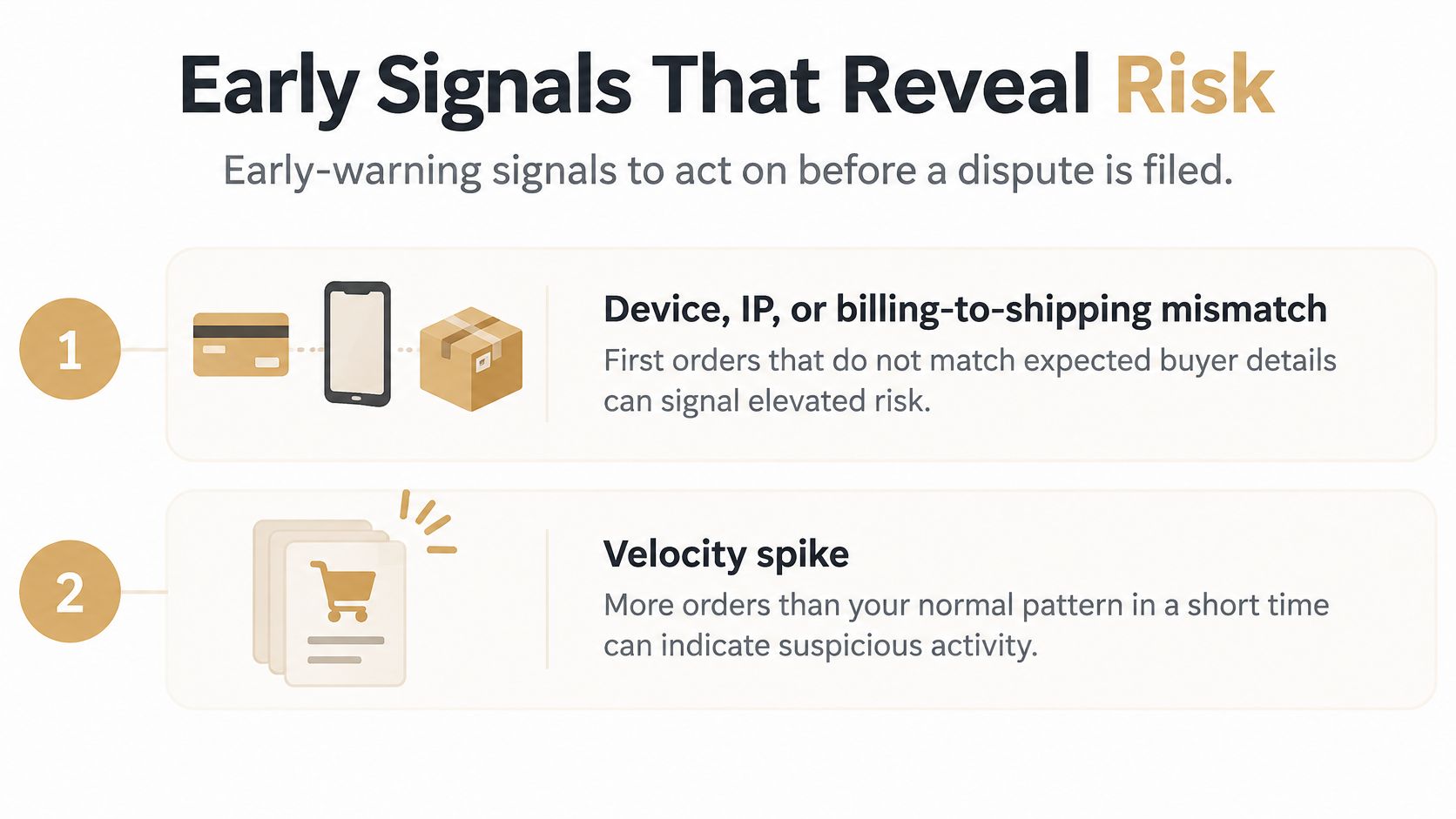
The visual highlights checkout signals that deserve attention before fulfillment.
Build an actionable checklist
- Buyer-detail mismatch: Device, IP location, or billing-to-shipping differences on a first order warrant verification because the buyer's details don't align.
- Velocity spike: An unusual concentration of orders from a card, email, or address may indicate testing or coordinated purchasing.
- Login followed by spending: A new device or country followed by a purchase deserves attention on an established account.
- Repeated refund requests: Requests across separate orders can reveal a pattern that an individual support ticket conceals.
- Authentication exceptions: Failed challenges or unexpected authentication outcomes deserve investigation rather than repeated retries without review.
- Recurring-plan complaints: Questions about trials, price changes, or cancellation can reveal a billing problem before customers contact their banks.
- Delivery exceptions: Orders beyond their promised arrival date without tracking progress need proactive customer communication.
Antom's dispute-monitoring guidance provides a reference for the monitoring layer. Connect those alerts to your order and customer records so staff can distinguish a payment concern from a fulfillment or service issue.
Measure the cost of intervention
Track loss per transaction, approval impact, false-positive rate, and dispute incidence by cohort. Separate first orders from established customers and subscription renewals from one-off purchases. Otherwise, a rule that helps a risky segment can look successful while unnecessarily declining reliable customers elsewhere.
I would set initial thresholds from your own recent baseline, then review flagged orders against comparable unflagged orders. A campaign launch, wholesale buyer, or gift purchase can produce unusual activity without abuse.
An alert is useful only when someone knows what evidence to check and what action they're authorized to take.
Give each signal a named owner and a weekly review. Record whether the intervention prevented loss, delayed fulfillment, or rejected a legitimate customer. If you're investigating a high chargeback rate, connect the increase to specific customer and order groups before tightening rules across the store.
How to Sort Disputes by Root Cause
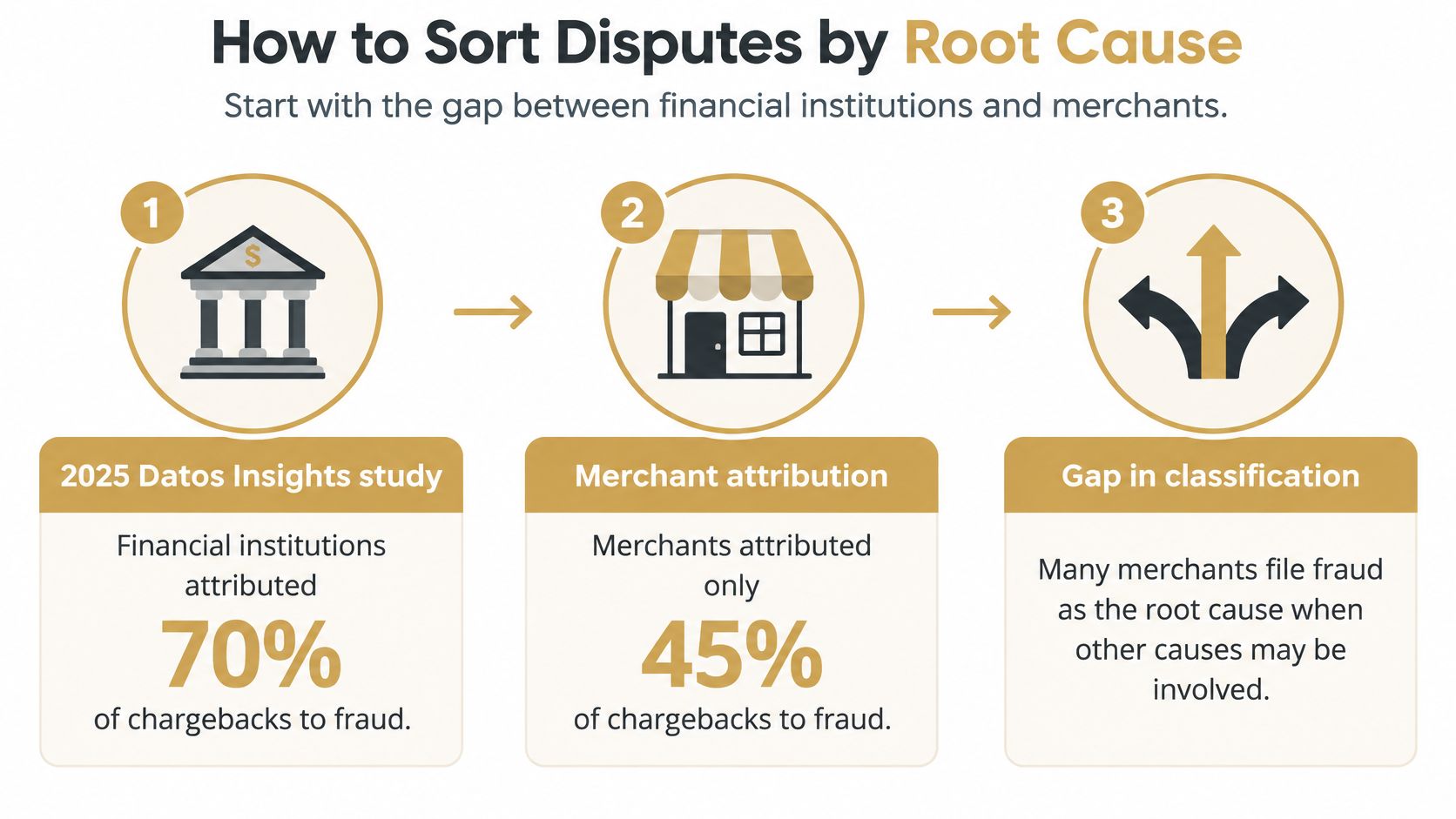
A 2025 Datos Insights study found that financial institutions attributed 70% of chargebacks to fraud, while merchants attributed 45%. That gap suggests a classification problem, but it doesn't prove that either party correctly identified every transaction.
The comparison makes the coordination issue visible.
Keep allegations separate from conclusions
Preserve the issuer's reason code, the processor's category, and your internal root cause as separate fields. Overwriting one with another destroys the trail your team needs to explain its decision.
- Collect the stated reasons. Pull the issuer reason code and the customer's explanation, including relevant support messages.
- Match the order evidence. Check delivery records, login history, consent records, product access, and prior refunds.
- Assign a working cause. Use genuine fraud or account takeover, first-party misuse, operational failure, or unclear billing. Mark uncertain cases for review rather than forcing certainty.
- Check account history. Look for related claims, changed addresses, cancellation attempts, and previously resolved complaints.
- Choose the response. Evaluate evidence strength, remaining response options, cost, and customer impact.
- Record the final cause. Make fraud reporting, support reporting, and dispute reporting use the same internal label.
Similar claims can require different actions
Say subscription-box customers both report non-receipt. For one customer, tracking records delivery to a neighbour and the account contains earlier non-receipt claims. That supports an abuse investigation, but it isn't conclusive proof of misuse: verify whether the neighbour was an authorized recipient and whether the customer obtained the parcel.
If supporting records establish receipt and contradict the claim, contesting may be justified. Include the relevant delivery evidence and communications rather than a large, unstructured export.
For the other customer, the order follows a password reset, a new-device login, and an unauthorized address change. If the customer confirms the account was compromised, treat it as account takeover: secure the account, revoke sessions, suspend use of the compromised stored payment method, and coordinate the financial response through the processor.
The same reported reason can conceal different failures. Delivery status alone doesn't establish intent, and a new device alone doesn't establish takeover.
Use the video as an additional discussion prompt when aligning the people who handle these cases.
The useful output is a defensible case record: what the customer alleged, what you verified, what remains uncertain, and why you chose the response.
Choosing Refund, Contest or Block Responses
A near-zero chargeback rate isn't automatically the right goal. The 2025 Global Payments & Fraud Report found that 57% of merchants reported rising refund or policy abuse, while 62% reported an increase in first-party misuse disputes.
Refunding every complaint can conceal losses rather than prevent them. Contesting every claim can be equally wasteful when your evidence is weak or the customer experienced a genuine failure.
Dispute response options by case
| Response | Use when | Cost to you | Risk if overused |
|---|---|---|---|
| Refund | Genuine service failure, or recovery isn't worth pursuing | Refund amount plus applicable fees | Rewards policy bypass and repeat abuse |
| Replace or credit | Customer wants the product and you can fix the failure | Product, fulfillment, or service cost; a credit creates a future obligation | Customer may still dispute if resolution is slow |
| Clarify descriptor or billing message | Customer doesn't recognize the charge | Support time | Delays a refund the customer deserves |
| Contest with evidence | Relevant proof is strong and expected recovery justifies the effort | Applicable fees, staff time, and uncertain recovery | Damages the relationship if the customer was right |
| Block or restrict | Confirmed compromise or a substantiated abuse pattern | Foregone sales and investigation time | Broad rules exclude legitimate customers |
Compare incremental expected costs
Use the decision point you're at. Before a chargeback, a refund might avoid an otherwise applicable dispute fee. After filing, some costs may already be unavoidable, so counting them only against contesting distorts the comparison.
For representment, estimate:
Expected recovery = probability of winning × recoverable amount.
Subtract incremental fees and staff cost, then consider repeat-abuse exposure, customer retention, and monitoring risk separately. Don't assign precise financial values to those factors unless you can defend your assumptions.
A history of refund requests doesn't automatically reduce your chance of winning. It may increase concern about future abuse, while your win probability should reflect the evidence relevant to the dispute. Blocking future purchases also doesn't resolve an existing claim.
Decision boundary: Contest because the evidence and economics justify it, not because the complaint feels unfair.
For marketplace operators, Online Brand Growth's Amazon seller account reinstatement strategies provide context on account-recovery planning. Keep marketplace remediation distinct from your payment-dispute decision, even when both require documented corrective action.
Write authorization rules before staff start acting on alerts. Through our dispute resolution process, we initiate refunds and communications with payment processors, alert networks, or related service providers only on the merchant's authorization. A refund decision should also include a status check to prevent duplicate reimbursement after a dispute has already progressed.
Building the Tooling and Process Stack
Build the stack around handoffs, not around a promise that software will make every decision. Each layer should supply evidence or execute a defined action, with a clear record of who authorized it.
Give each layer a distinct job
- Processor rules and authentication: Apply checkout checks, route appropriate transactions through authentication, and retain the outcomes.
- Device and identity signals: Connect login, account changes, and purchase activity so investigators can examine the sequence.
- Dispute alerts and resolution services: Use relevant issuer and network services, including Visa RDR and Ethoca, according to their supported workflows. Distinguish automatic resolution from alerts that require merchant action.
- Dispute analytics: Show cause, loss, and incidence by cohort, using consistent denominators and reporting periods.
- Case log: Store the reason code, internal cause, evidence, response, authorization, and outcome together.
- Operational review: Assign someone to investigate exceptions, approve rule changes, and verify that integrations still work.
An alert service belongs inside this stack. It receives eligible events and applies your configured workflow; it doesn't repair misleading product descriptions or reconstruct missing cancellation records.
For Shopify operators, a Shopify chargeback protection workflow should connect fulfillment and tracking information with payment records. Make sure staff can identify an already refunded order before approving another action.
Understand funds and data access
Ask whether a provider holds customer funds and which organizations receive customer data. Those questions affect your operating controls, not just procurement paperwork.
We don't hold or control merchant or customer funds. All funds movement occurs through your payment processor or acquiring bank.
We share order and customer data with payment processors, card networks, and banks when processing dispute responses, chargeback representations, or fraud investigations, as authorized by merchant clients. Document the access granted, restrict staff permissions, and maintain an escalation route for incorrect actions.
Industry-specific obligations also need their own review. For operators serving gaming businesses, Top 1 Rank's payment compliance guidance for iGaming suppliers offers a starting point for identifying payment-accreditation questions. Confirm applicable requirements with qualified advisers rather than treating a general guide as approval to operate.
Finally, test the unglamorous failures: disconnected processors, missing order identifiers, duplicate alerts, and unavailable reviewers. A well-designed workflow must tell staff what to do when the integration can't complete an action, not only when everything works.
Set Up Your Risk Review This Quarter
Start with a review you can repeat, not a complicated scoring model nobody maintains. Use a recent operating period long enough to include completed dispute outcomes and separate unresolved cases from confirmed losses.
- Export and classify disputes. Apply a consistent cause label while preserving issuer and processor categories.
- Calculate cohort economics. Compare loss per transaction and dispute incidence for first orders, renewals, and relevant product groups.
- Write the decision table. Specify refund, contest, and restriction criteria, including escalation and authorization.
- Assign signal owners. Put a recurring review on the calendar and record every rule change.
- Test an alert layer if justified. Compare its cost and outcomes against your own baseline, including unnecessary refunds and staff effort.
If you test Disputely, we connect to Stripe, PayPal, Shopify Payments, Authorize.net, and Square. Our dashboard lets merchants track every dispute, monitor their chargeback ratio, and see how much revenue is saved.
We don't guarantee dispute prevention, chargeback reduction, processor approval, account standing, or avoidance of reserves, monitoring programs, or account termination. Judge the test by net financial results and operational accuracy, not a promised outcome or a declining dispute count alone.
Disputely offers chargeback alerts, authorized refund initiation, and dispute management to support your merchant risk management workflow. Visit Disputely to evaluate how those services fit your processor setup, then test them against your own dispute history and written response rules.


