
Payments and Subscriptions: A Guide to Billing and Disputes
U.S. ecommerce sales reached $310.3 billion in one quarter, representing 16.4% of total U.S. retail sales, according to the U.S. Census Bureau retail ecommerce release for the third quarter of 2025. That's roughly one dollar in every six spent at U.S. retailers moving online. At that scale, payments and subscriptions aren't a checkout detail. They're the system that decides whether revenue renews, fails quietly, or returns as a dispute.
Subscription Billing Models Compared
Your billing model decides how often you charge the card, how predictable each amount is, and where payments are most likely to break. A fixed charge creates repetition. A variable charge creates questions. Those two risks need different controls, which is why the model comes before any retry or dispute advice.
Digital payments now support that recurring activity at global scale. The World Bank Global Findex data on digital merchant payments shows digital merchant payments reached 42% of adults globally in 2024, up from 35% in 2021. More customers paying online and by phone means more stored credentials, more automatic renewals, and more chances for an outdated card or unrecognized amount to interrupt revenue.
Five models and where each one breaks
| Billing model | How the charge works | Typical fit | Main payment risk |
|---|---|---|---|
| Fixed monthly | Same amount on a set date each month | SaaS, memberships, subscription boxes | Card expiry and declines hit every cycle |
| Annual prepaid | One charge covering twelve months | Software, publications, annual memberships | A large single charge is often disputed when a renewal reminder is missed |
| Usage-based metered | Charge follows measured consumption | APIs, cloud hosting, utilities | Variable amounts lead to unrecognized-charge disputes |
| Tiered or seat-based | Amount changes with plan tier or number of users | B2B SaaS | Mid-cycle upgrades create prorated charges that confuse customers |
| Hybrid base plus usage | Fixed fee plus variable overage | Platforms, telecom, data services | Two line items on one statement make the descriptor and breakdown matter |
Keep this table in mind as you set retries, reminders, and dispute rules. Each row points to a different failure.
Fixed monthly is one of the two models most businesses run. It's easy for customers to understand, but one expired or replaced card can fail every cycle until someone updates it. The amount rarely causes confusion, so your priority is keeping the credential current.
Tiered or seat-based billing is the other common model, especially for B2B software. The risk isn't repetition, it's change. Say a team adds five seats halfway through a cycle. You may charge a prorated amount now and a higher full amount next month, so the customer sees two unfamiliar figures in a short period.
Annual prepaid plans concentrate risk into one large renewal. Usage-based and hybrid plans spread the risk across amounts that move. In each case, the charge most likely to be questioned is predictable if you look for it.
Count how many charges a customer sees in a year under your model, then name the one most likely to surprise them.
That charge needs your clearest invoice breakdown, your strongest advance reminder, and a statement descriptor the customer recognizes. Treat that quick count as your first audit before you change anything else.
Recording Consent Before the First Charge
A link to your current terms doesn't prove what a particular customer accepted months ago. Terms change. Prices change. Trial dates pass. If you can't reconstruct the exact offer shown to that person, you're relying on a generic page to defend a specific charge.
Visa's subscription merchant guidance requires merchants to communicate subscription terms electronically at enrollment, including the start date, goods or services, recurring amount, billing frequency or date, and a simple mechanism for cancelling subsequent transactions. For free trials or introductory promotions, you also need evidence that the cardholder expressly agreed to future charges and that you notified the customer before processing charges after the promotional period.
Capture consent in five steps
- Show the exact offer at checkout. Display the price, interval, start date, and what happens when a trial ends. Don't bury the recurring amount below the payment button.
- Capture explicit agreement. Record the action that shows the customer accepted continuing billing, not just account creation. This separates permission to use the product from permission to charge again.
- Send written confirmation. Include the terms and a direct route to cancel. Keep the confirmation message ID so you can prove what was sent.
- Store a versioned consent snapshot. Save the plan ID, price, billing interval, trial end date, disclosure text hash, IP address, user agent, and confirmation message ID against the subscription. A hash lets you verify the disclosure wording without guessing which version was live.
- Remind before money moves. Send a notice before the trial ends, before an introductory price expires, or before a price change takes effect. The reminder reduces surprise and creates another timestamped record.
Why store technical details such as IP address and user agent? They help connect the checkout session to the subscription record when a customer later says they never agreed. They don't replace clear wording, but they make the chain of evidence harder to break.
Practical test: Pick one active customer and try to rebuild, within ten minutes, the exact offer they accepted.
If your team has to search old web pages, pricing documents, and email systems, your consent record isn't complete. Store the snapshot with the subscription itself.
Failed Payment Causes and Recovery Decisions
A failed renewal isn't automatically a lost customer. Sometimes the customer still wants the service and has no available balance that day. Sometimes the issuer is signaling risk, and pushing harder makes matters worse. The decline reason should decide your next move.
The 2025 Churnkey State of Retention benchmark, analyzing more than $3 billion in subscription revenue and 6 million failed payments, found involuntary churn generally around 1%, with insufficient funds representing 42.3% of declines and risk-management reasons accounting for roughly 25 to 30%. Those two large groups need opposite responses.
Match the response to the reason
| Decline reason | Share of declines | Recovery response |
|---|---|---|
| Insufficient funds | 42.3% | Retry around pay dates and prompt a payment method update |
| Risk-management decline | roughly 25 to 30% | Pause retries and ask the customer to verify |
| Expired or replaced card | Not stated as a separate share | Run the account updater before the next cycle |
| Hard decline, such as lost or stolen card | Not stated as a separate share | Stop retrying the same card and request a new payment method |
For insufficient funds, timing matters. A retry after a likely pay date may succeed, while several attempts on the same day usually won't. Send a calm update prompt too, since the customer may prefer a different card. If you need wording that asks without sounding like a collections notice, AurenWell's due date reminder templates give you a useful starting point for due date and payment update messages.
For risk-management declines, use restraint. The issuer may be suspicious about the transaction, the credential, or the pattern of attempts. Pause automatic retries and ask the customer to verify or replace the payment method through your secure billing page.
Expired or replaced cards need a quieter fix. An account updater checks participating issuers for new card details attached to the stored credential. Run it before renewal where available, then tell the customer which card will be charged if the last four digits changed.
Decide how hard to pursue recovery
Use more than the amount owed. Weigh the transaction value, customer tenure, usage after the last bill, decline reason, prior dispute history, geography, and subscription status together.
- Long tenure and recent usage: Offer a generous grace period and several clear chances to update payment details.
- New account and prior dispute: Pause sooner and require a verified payment method before restoring full access.
- High value and active usage: Add a personal outreach from support or account management, not only automated email.
- Cancelled status: Stop recovery entirely. A customer who has cancelled isn't a failed renewal to win back through billing.
Track the results as one system. Measure net recovered revenue, preventable disputes, refund cost, repeat disputes, and involuntary churn together each month. If recovered revenue rises while repeat disputes rise faster, your recovery process is creating tomorrow's chargebacks.
Retry Schedule for Failed Renewals
Dunning is the timed process you use after a payment fails. It isn't one more retry whenever someone remembers. Each attempt and message should give the customer a clearer choice: update the payment method, pause, or leave cleanly.
The schedule below is a starting point to test against your own recovery data. Your billing interval, product margin, and customer pay patterns may justify shorter or longer gaps. What shouldn't vary is the logic. Early attempts catch temporary problems, middle messages help the customer fix the card, and the final step ends access predictably.
A starting dunning schedule
| Days after decline | Retry or action | Customer message |
|---|---|---|
| 0 | First decline recorded | None, or a quiet notice in the app |
| 3 | Automatic retry | Email asking the customer to check the card |
| 5 | Retry with account updater check | Email with a one-click card update link |
| 9 | Retry | SMS or push reminder with the update link |
| 30 | Subscription cancelled | Written confirmation with the end date |
On day 0, record the decline reason and protect the account from duplicate attempts. A quiet in-app notice works for active users. Sending an alarming email immediately can be unnecessary if a short delay would solve a balance problem.
By day 3, retry once and explain the failure in plain language. Say what amount didn't go through, what service it covers, and where to update the card. Don't make the customer log in, hunt through settings, and guess which menu holds billing.
On day 5, check for updated card credentials before retrying. Send a one-click update link that opens the secure payment form directly. If you're reviewing the mechanics of these emails, retries, and grace periods, our guide to dunning management breaks down how to structure the sequence.
The day 9 reminder should be shorter and more direct. State when access will pause if payment isn't fixed. A pause is often better than immediate cancellation for products where customers store projects, history, or settings, because it preserves the account and makes reactivation cheap.
A pause protects the relationship without giving away unpaid service indefinitely.
At day 30, cancel if the customer hasn't paid or responded, and confirm the end date in writing. Tell them what happens to stored data and how to restart. A clean ending creates fewer disputes than an account that keeps attempting charges while the customer assumes it's closed.
There's one major exception. If the issuer returns a hard decline, such as a card reported lost or stolen, stop retrying that card. Ask for a new payment method instead. Repeated attempts waste authorization requests and can make your billing pattern look worse.
Log every attempt with its timestamp, amount, decline response, and message sent. Those records show whether your schedule works, and they'll matter if a later successful charge is questioned.
Cancellation Rules That Stop Post-Cancel Charges
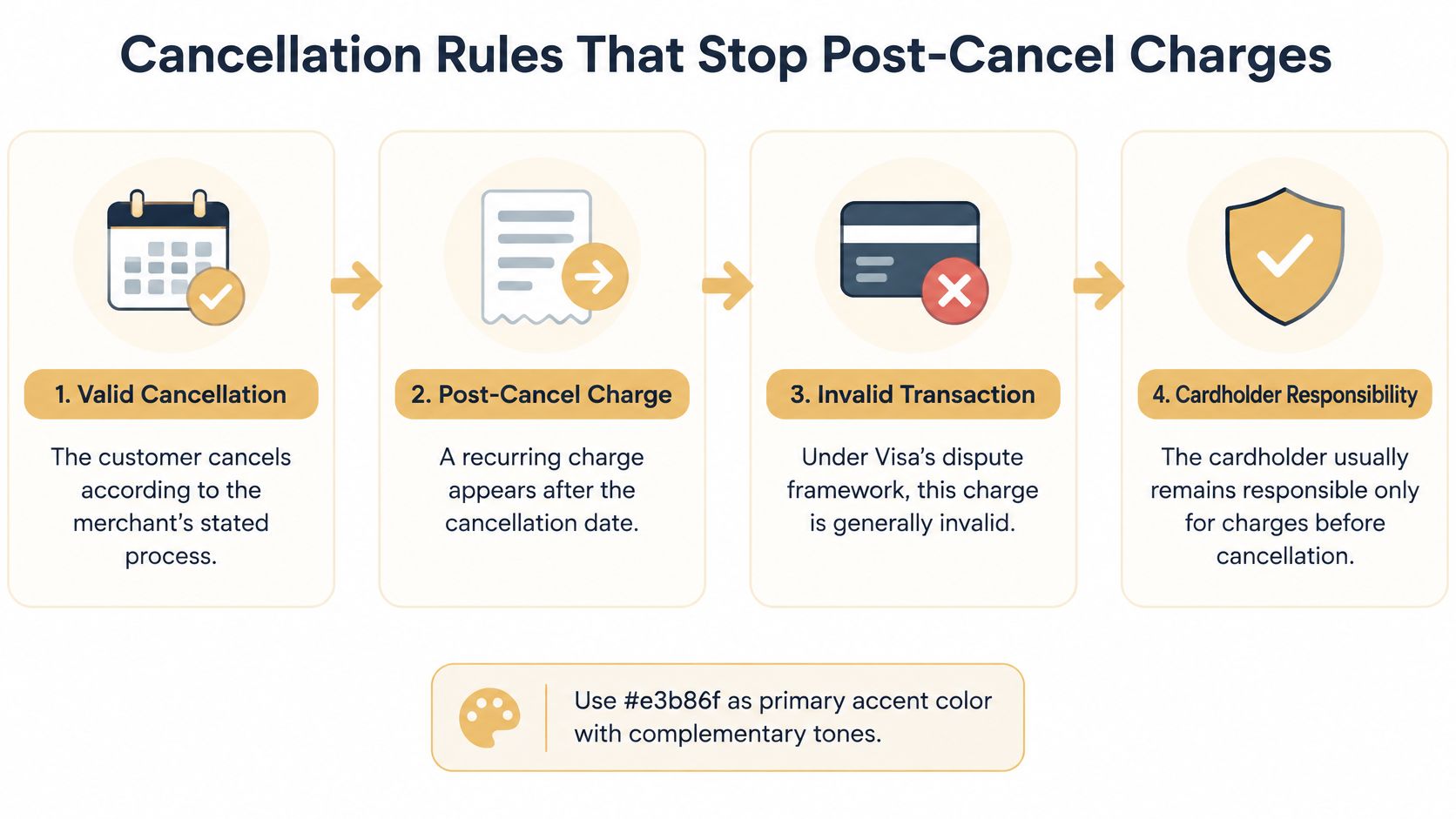
A charge after a valid cancellation is one of the hardest subscription charges to defend. The Visa merchants dispute management guidelines state that a recurring charge after a valid cancellation is generally treated as an invalid transaction, while cardholders generally remain responsible for transactions processed before the cancellation's effective date.
Most post-cancel charges aren't deliberate. The cancellation is saved in your customer account system, but the billing scheduler has already created the next invoice. A queued retry then runs days later, and neither system checks the other's current state.
Make cancellation a hard billing block
- Store the full cancellation record. Save the cancellation timestamp, effective service period, payment token identifier, and billing schedule. These fields connect customer intent to the exact credential and cycle.
- Block later authorization or capture. Don't allow a recurring charge after cancellation unless the customer explicitly re-enrolls. Make this a system rule, not a support agent's memory.
- Check again before invoice finalization. Run the cancellation check immediately before billing, not only when the cycle was first created. This catches cancellations submitted after an invoice entered the queue.
- Cover every delayed job. Apply the same check to retries, account updater events, and asynchronous payment jobs. A retry scheduled before cancellation must not fire afterward.
- Confirm in writing. Send the effective date and explain any charge already processed for the current period.
If you want to offer an alternative before someone completes cancellation, keep it optional and easy to decline. For Shopify stores considering that route, store credit for Shopify cancellation requests explains how store credit can be presented during a cancellation request. It should never delay or replace the cancellation itself.
This area also overlaps with recurring offers where silence or inaction leads to another charge. Our explanation of negative option billing covers why clear consent and cancellation access matter for those models.
A clean audit trail for one customer is simple to export. It shows when they cancelled, when service ends, which token was blocked, which queued jobs were stopped, and when written confirmation was sent. If those events sit in five separate systems with no shared timestamp, fix that before renewal day.
Disputes That Are Not Fraud and How to Respond
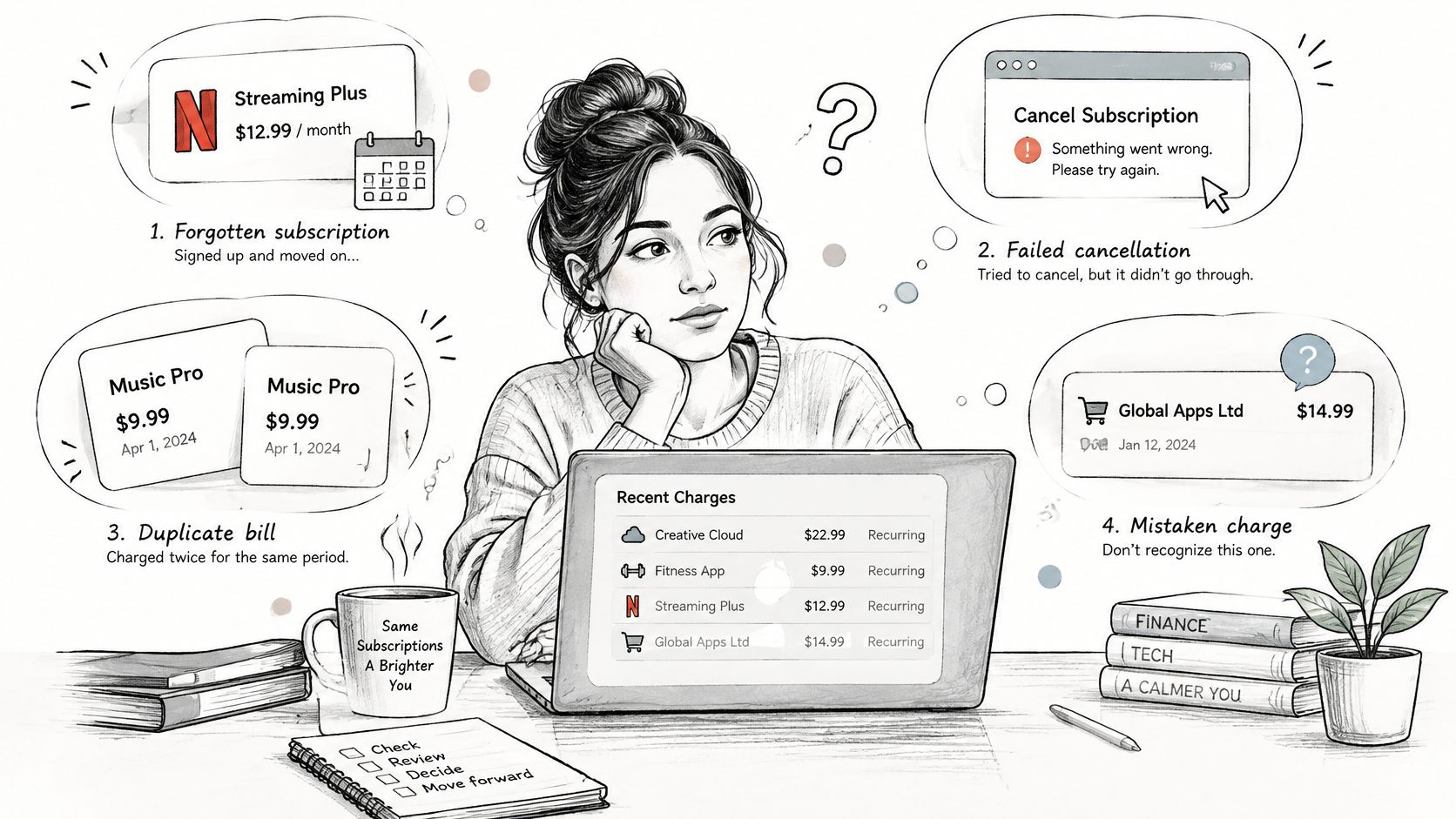
Not every dispute means a criminal used a stolen card. A loyal customer may forget signing up, miss the cancellation confirmation, see an unfamiliar descriptor, or disagree with a usage total. Treating that person like a fraudster can turn a fixable billing problem into a lost account and a formal chargeback.
The Mastercard subscription economy report reports that 29% of consumers have disputed a recurring payment because they thought it might be fraudulent, while 25% have blocked a payment for the same reason. It also found 70% of surveyed U.S. businesses say disputes and chargebacks have a medium or high business impact. Recognition is therefore a payment control, not just a branding preference.
Triage by customer intent
| Case | First action | Evidence to capture |
|---|---|---|
| Cancellation was clear before the charge | Immediate refund | Cancellation timestamp, effective date and written confirmation |
| Customer does not recognize the charge | Immediate refund | Consent record and the descriptor shown on the statement |
| Usage-based disagreement | Evidence review | Usage logs, invoice breakdown and the versioned consent snapshot |
| Duplicate billing | Refund the duplicate | Invoice IDs, billing schedule and payment attempt timestamps |
| Merchant evidence is strong | Escalate to representment | All evidence above plus customer delivery metadata |
Refund quickly when the facts are against you. If the customer cancelled in time, was charged twice, or doesn't recognize your descriptor, a prompt refund stops the problem from growing. Capture the evidence first so you can fix the process that caused it.
Pause for review when the disagreement concerns usage. Compare the invoice with metered activity, seat changes, delivery records, and the version of the plan the customer accepted. Show the customer the breakdown before assuming they'll accept the total.
Escalate to representment, which means submitting evidence to challenge the dispute, only where your records are strong and complete. Consent alone may not be enough if usage, delivery, and cancellation records contradict each other. If you're sorting a customer's stated reason into the right response path, our overview of reasons to dispute a charge can help your team use consistent language.
Prevention is usually cheaper than winning. Use a recognizable descriptor, send pre-renewal reminders, provide one-click cancellation, confirm cancellation in writing, and refund obvious errors fast. Each improvement lowers the number of customers who ask their bank to interpret your billing for them.
Set Your Chargeback Prevention Plan Before Renewal Day
Don't wait for renewal day to discover that consent records are missing or cancelled accounts are still in the retry queue. Build the controls as one monthly operating routine. The aim isn't to add friction everywhere. It's to place the right check at the moment when money is about to move.
Your five-step pre-renewal checklist
- Confirm the billing model and descriptor. Find your model in the comparison table, then check the exact name customers see on statements. If your legal name differs from your product name, explain both in receipts and account pages.
- Verify versioned consent records. Sample active subscriptions across plans, trials, and older signup flows. Every sampled account should show the accepted price, interval, trial terms where relevant, and cancellation route.
- Set dunning and the hard-decline exception. Confirm retry dates, message copy, grace period, pause rules, and the point where staff stop retrying a lost or stolen card.
- Test cancellation across delayed jobs. Cancel a test subscription after an invoice and retry are queued. Confirm that invoice finalization, retries, and account updater events all stop.
- Assign dispute triage ownership. Name who reviews alerts, who approves refunds, and who decides whether evidence is strong enough for representment. A shared inbox with no owner isn't a process.
An alert service is one optional control within that system. It flags a dispute earlier so you can decide whether to refund before it becomes a chargeback. For context, Disputely connects to Stripe, PayPal, Shopify Payments, or any other payment processor, and you only pay when Disputely prevents a chargeback from hitting your account. Confirm current integrations and pricing directly with any vendor before relying on them in your billing process.
Run the checklist before each major billing cycle, not only after disputes spike.
Then review the same five measures each month: net recovered revenue, preventable disputes, refund cost, repeat disputes, and involuntary churn. Compare results before and after each change. If you shorten dunning, watch whether involuntary churn rises. If you refund alerts faster, watch whether repeat disputes fall enough to justify the refunds.
Change one control at a time where you can. That makes cause and effect visible. Payments and subscriptions work as a connected system, so a clearer descriptor can reduce disputes, a better cancellation block can reduce refunds, and a smarter retry can recover revenue without annoying the customer into calling their bank.
When a subscriber disputes a renewal, Disputely alerts you early so you can review the case and refund where appropriate before it becomes a chargeback. Connect your payment processor, set your refund rules, and protect your recurring revenue without adding manual work for your team. Visit Disputely to see how early dispute alerts fit into your subscription billing process.


