
Transaction ID Tracking for Faster Dispute Resolution
The most common advice about transaction ID tracking is to save the transaction ID and use it to find a payment. That sounds sensible until support searches an order number, finance searches a payout, and neither matches the processor's record. A payment lifecycle doesn't have one universal ID. It has related identifiers for the order, payment, refund, dispute, settlement entry, and payout. The practical job is to preserve their parent-child relationships so each team can follow the same sale.
Which Transaction ID to Store at Each Stage
There's no single transaction ID that joins a storefront, processor, refund, dispute, and bank deposit. Store each identifier with the lifecycle object it represents, then link those records to the same order and payment attempt.
| Stage | ID to store | What it matches | Do not substitute |
|---|---|---|---|
| Customer order | Merchant order ID | Support, cart, and fulfillment | Processor payment ID |
| Payment or charge | Processor payment or charge ID | Authorization and capture at the processor | Storefront order number |
| Refund | Refund ID | Full or partial refund of a parent charge | Original charge ID alone |
| Dispute or alert | Dispute ID | Chargeback or pre-dispute case | Payment ID |
| Payout reconciliation | Balance transaction ID and payout ID | Bank deposit and fee netting | Order ID |
| Card-network trace | RRN (data element 37) and STAN (data element 11) | Acquirer and issuer messages | Internal database key |
| Retry control | Idempotency key plus payment-attempt ID | Safe retries of the same operation | A new key on every retry |
The lookup path should match the team's question. Support starts with the merchant order ID to find the customer's cart and fulfillment record. Payments opens the processor payment or charge ID to inspect authorization and capture. Finance follows the balance transaction and payout IDs to see how processor activity connects to a bank deposit. A dispute analyst uses the dispute ID to open the case, then follows its payment parent to confirm which sale is involved.
That separation matters in real storefront integrations. Shopify's guidance for third-party payment providers says the payment ID is what gets sent to the provider for reconciliation. An order number on its own may not locate the processor record. Stripe also uses a distinct balance transaction ID for payout reconciliation, so the payment ID and settlement reference aren't interchangeable.
A single order can produce several payment attempts, captures, or refunds. Subscriptions add recurring charges; partial refunds create their own records; marketplace settlement can split money across accounts. If the data model stores only one “transaction ID” on the order, a later attempt may overwrite an earlier one, or a refund may become detached from the charge it adjusts.
Card-network references serve a different purpose. The RRN and STAN help identify and trace card messages between payment participants, but they aren't substitutes for a storefront order key. Preserve them when available, alongside the processor and merchant identifiers.
Working rule: Store the identifier for each object, then record its parent. Don't expect one ID to do both jobs.
Build One Canonical Reference Across Logs and Webhooks
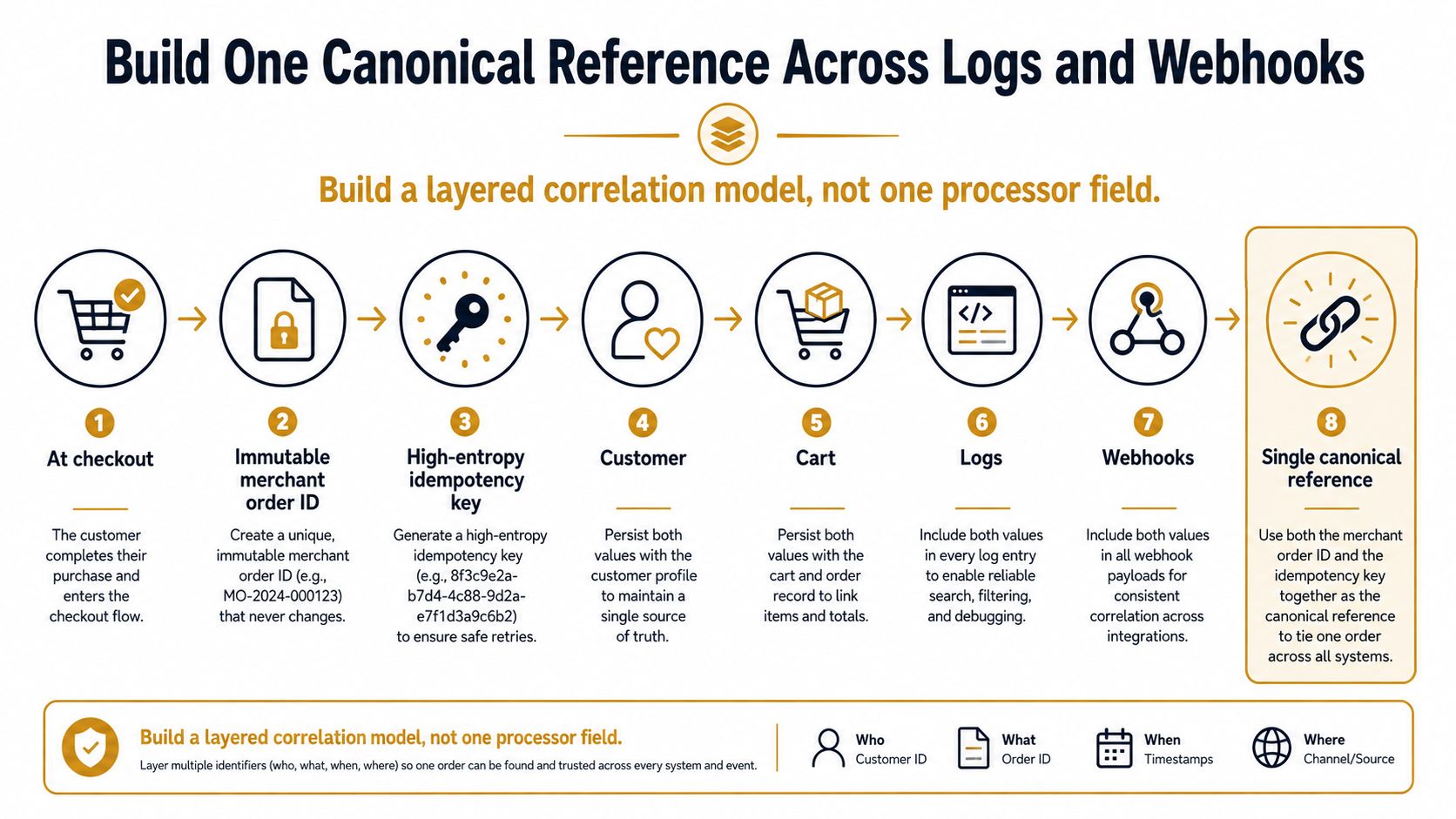
A reliable transaction ID tracking system is a layered correlation model, not a search box built around one processor field. Create one canonical reference for the order's payment lifecycle, then map provider-specific IDs and event records to it without discarding the originals.
1. Establish the checkout identifiers
At checkout, create an immutable merchant order ID and a high-entropy idempotency key for the payment operation. Persist them with the customer, cart, payment attempt, processor account, and currency metadata. That context lets a later webhook or support query locate the order without guessing from a name or timestamp.
2. Send the original idempotency key
Send that key with the server-side payment request and keep it for the life of the operation. Stripe recommends sufficiently unique idempotency keys for POST requests and retains keys for at least 24 hours; using a key again after it's removed can execute a new operation, as its low-level error guidance explains. A customer ID alone is predictable and can collide across attempts. Generating a fresh key for every retry defeats the control.
3. Append processor IDs, don't overwrite history
After each response, store the processor payment, charge, refund, and balance transaction IDs with the relevant payment attempt. Keep prior attempts as separate records. Overwriting them can make an old attempt appear to be the current paid transaction, or leave a refund pointing to the wrong charge.
4. Map provider IDs to a canonical reference
Create the canonical reference at authorization and associate it with the capture, refund, subscription or invoice, and ledger entry. Transmit it in supported metadata, webhook, remittance, and export fields. ISO 20022's EndToEndId is designed to be assigned by the initiating party and passed unchanged through a payment chain for reconciliation; its addressing guidance also distinguishes it from interbank transaction identification.
When a provider truncates or replaces a value, maintain a translation table with the original and normalized references, source system, timestamp, and parent ID. Authorization IDs, settlement IDs, and webhook event IDs identify different objects. Treating them as interchangeable breaks the chain.
5. Reconcile before retrying an unknown result
If a network timeout leaves the payment result unclear, retrieve and reconcile using the original key and merchant order ID before sending another payment request. A timeout doesn't prove the processor didn't act. Retrying immediately with a new key can create a duplicate charge.
6. Enforce uniqueness and review exceptions
Enforce uniqueness on (merchant_account, idempotency_key) and separately on (merchant_account, payment_attempt_id), while allowing one order to have multiple attempts. Reconcile on webhook receipt, settlement-file ingestion, refund creation, and a scheduled exception run. Compare amount, currency, status, and parent-child IDs; reject malformed or unexpectedly changed references, and block automated refunds or ledger posting when a mismatch remains unexplained.
For examples of how event delivery fits into the design, use this guide to webhook configuration. If your wider tracking stack also needs to preserve attribution across systems, first-party IDs for affiliate attribution offers useful context on keeping identifiers under your control.
The same correlation principle applies to commerce and marketing events: connect them through explicit references rather than assuming that one system's ID will work everywhere.
Prove the Chain Before Going Live
Don't connect alerts to automated refunds until test transactions prove that the ledger can trace each event to its parent. Run the cases in order and record the expected relationship and pass condition for each one.
Complete a successful payment. Confirm that the merchant order ID, processor payment ID, and balance transaction ID resolve to the same payment record. This validates the ordinary lookup path before edge cases enter the picture.
Simulate a network timeout. Retry with the original idempotency key and confirm that you retrieve the original payment rather than create another charge. A pass means one payment exists for that operation, not two records with similar amounts.
Issue a partial refund. Confirm that the refund ID is a child of the original payment and that the remaining refundable amount is correct. The refund should be visible as its own event, not as an edit that erases the original charge.
Replay a webhook. Confirm that the system recognizes the same event ID and doesn't create a second dispute or payment row. Webhook delivery can repeat, so the ledger must tolerate replay without duplicating the underlying event.
Reconcile a payout. Choose a payout and verify that its balance transaction maps to the relevant deposit line at the net amount. A payment can be linked correctly to its order while fees or other adjustments change the deposited amount.
Record the input, expected parent-child link, observed result, and pass or fail status for each test. Keep an audit trail of test results and changes; practical audit log retention best practices can help teams decide what to preserve for later investigation.
If a test leaves an unknown parent, block the automated refund rule until the missing relationship is fixed.
Why a Valid Transaction ID Still Fails to Match
A payment can be linked to its order and still be absent from the bank deposit the finance team expected. That isn't necessarily a bad ID. Reconciliation has two stages: match the payment event to the order, then match the transaction to the payout. Stripe's transaction-detail reporting guidance describes comparing transaction-level net amounts with bank deposits and notes that settlement may fall in a different period. Refunds and disputes can also change a payout or hold funds.
Classify the mismatch before changing a ledger entry or issuing a refund:
| Exception | What you see | What to do |
|---|---|---|
| Timing | Captured payment missing from this deposit | Check the next settlement period before re-posting |
| Missing identifier | Webhook or file row with no parent payment | Retrieve by idempotency key or order ID and backfill |
| Amount variance | Gross checkout total differs from net deposit | Compare fees, FX, and partial amounts, not gross |
| Duplicate | Same event delivered more than once | Collapse on webhook event ID; don't create a second charge |
| Currency | Presentment currency differs from settlement | Store both currencies and the converted amount |
| Refund | Payout reduced with no missing sale | Link the refund child to the original payment |
| Dispute or reversal | Funds on hold or pulled from a batch | Keep a separate dispute object; don't edit the sale |
| Payout batch | Sale sits in a different deposit | Match the balance transaction to the payout ID |
Each label points to a different repair. Timing means the capture exists, but the deposit belongs to a later settlement period. Missing identifier means an event or file row lacks its parent; retrieve the payment and backfill the link instead of matching on a customer name or a loose timestamp. For an amount variance, compare net settlement, fees, currency conversion, and partial amounts, not just the checkout gross.
A duplicate often means the same webhook arrived again. Collapse it by event ID; don't represent a replay as a second charge. If the issue is a refund, attach its record to the original payment. A dispute or reversal needs its own object, because it changes the movement of funds without changing the original sale. For a payout-batch mismatch, find which payout contains the balance transaction before posting the deposit.
Third-party payment integrations can add another lookup gap: an order ID may not be the reference available for processor reconciliation. For card investigations, the ARN number and its role in transaction tracing can provide another useful reference where applicable.
Every unmatched row should receive one of these classifications before anyone posts a ledger entry or issues a refund. A searchable ID helps locate records; it doesn't make payout matching automatic.
Tie Alerts to the Right Order in Minutes
When an alert lands, search in a fixed order. Starting with a customer name, email, or broad timestamp window invites collisions, especially when a subscriber has several charges close together. Confirm the payment and its status before anyone decides whether to refund.
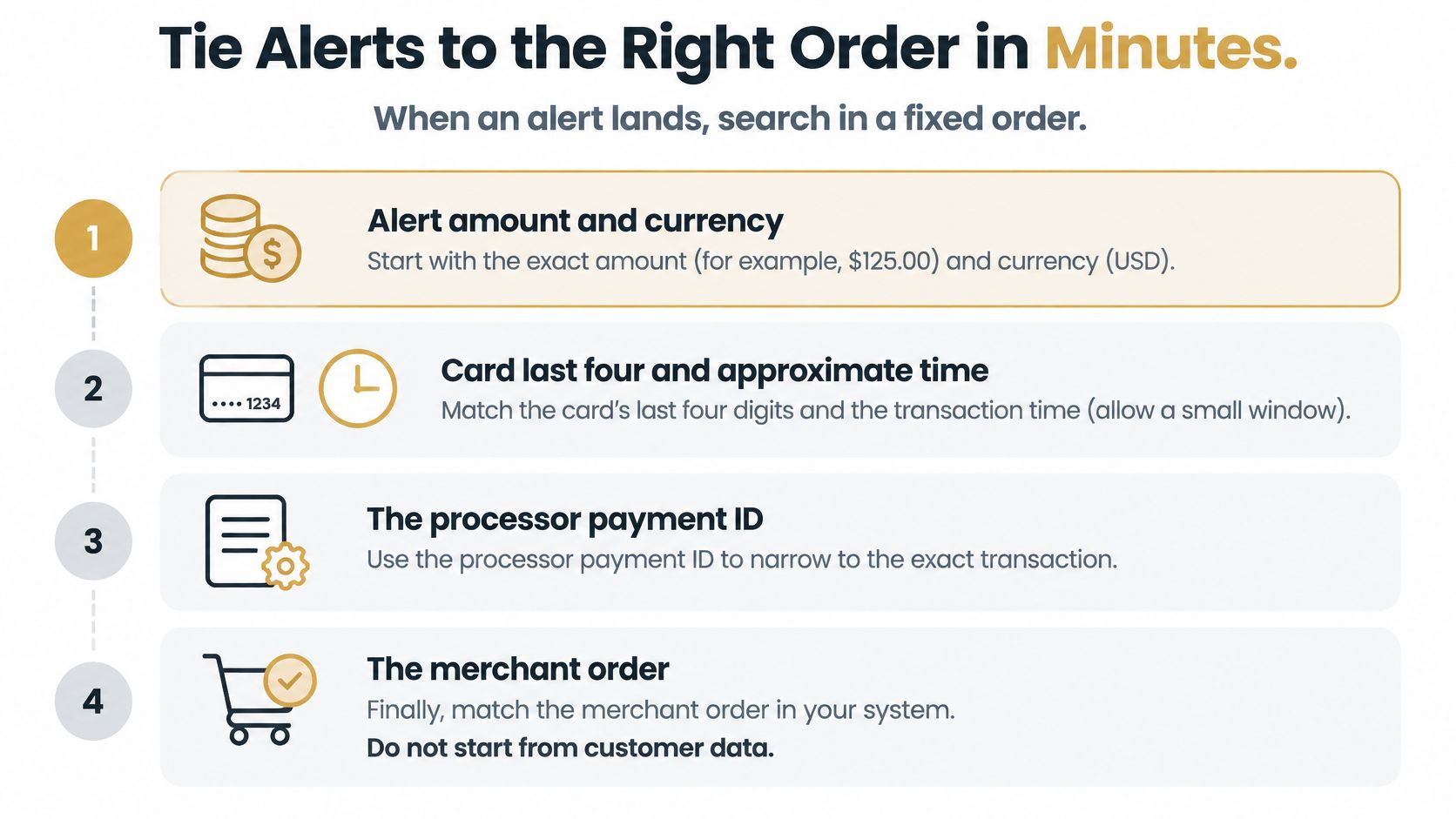
- Alert amount and currency. Use the alert's amount and currency as the first filter.
- Card last four and approximate time. Narrow the candidate set without treating either detail as a unique ID.
- Processor payment ID. Open the payment record and check whether it's captured or only authorized.
- Merchant order. Confirm the associated cart and fulfillment record after the processor match is established.
Keep webhook event IDs in their own field, so a replay doesn't look like a second dispute. An alert against a captured charge requires a different decision from an alert against an authorization that hasn't been captured. For a partial refund, open the refund child and confirm the remaining amount before issuing anything else.
The RRN and STAN can help teams trace related card messages across the acquirer and issuer. The Worldpay ISO 8583 reference guide describes the RRN as a transaction reference used to connect related payment messages, while the STAN identifies a transaction and is mirrored in the response. They're network-level references, not replacements for the merchant's order ID or processor payment ID.
Build the evidence packet with the canonical reference, processor payment ID, any refund IDs, dispute ID, and available network references. Record who matched the alert, which identifier they used, and whether a refund was sent. A dispute alert workflow can help teams organize alerts, but the match still depends on preserving the path from alert to payment and order.
Match Alerts Before the Chargeback Window Closes
A transaction ID is only useful if its parent-child links survive the alert, refund, and payout stages. Keep the order ID, payment ID, refund ID, dispute ID, balance-transaction ID, payout ID, and idempotency key in one searchable ledger, with explicit links between related records. Before connecting an alert to a refund rule, test timeouts, refund handling, webhook replays, and payout matching.
Treat an alert as a reason to investigate, not proof that a specific order should be refunded. Apply the merchant's authorized refund rule only after matching the alert to the payment and order. Send ambiguous cases to an exception queue rather than letting automation guess. Recurring charges and high-volume carts need particular care: similar-looking payments may belong to different order cycles.
Disputely monitors transactions 24/7 and alerts merchants to disputes immediately. Its dashboard tracks disputes, chargeback ratios, and revenue saved. Disputely's Verifi Network (CDRN) coverage provides direct issuer alerts and 72 hours to refund and stop chargebacks. For a practical overview of how Ethoca alerts fit into dispute workflows, keep the alert record connected to the underlying payment rather than treating it as a standalone transaction.
The operational goal is for support staff to open an order and find its correct payment, refund, dispute, balance transaction, and payout without rebuilding the trail by hand. Alert timing helps, but it cannot fix a broken match. Establish the ledger links first, then connect alerts only to records that can be identified reliably.
Disputely connects dispute alerts with payment records so your team can match a case to the right order before deciding whether to refund. Set up the payment-event ledger first, then visit Disputely to see how its alert workflow can support that process.


